
LOSSES AND QUESTIONS

EF-5 Tornado rips through Joplin, Missouri May 23, 2011

I spent Sunday evening and Monday morning researching the damage the EF-5 tornado did to my hometown of Joplin, Missouri Sunday. Sirens alerted residents of a dangerous situation at 5:11 PM. Twenty minutes later, a tornado, three-fourths of a mile wide with wind velocities over 200 mph, slammed down on the southwest side of town and ripped a swath through six miles of residential and business areas.

A view down Range Line

Located in tornado alley, Joplin is no stranger to severe spring storms. Since moving back to Joplin in 1961, I have huddled in a bedroom closet (we did not have a basement) on more than one occasion, hoping the spotted funnel cloud would not touch down on our house. Some did touch down in and around the Joplin area, but nothing in my memory comes close to the devastating scenes I have viewed online.
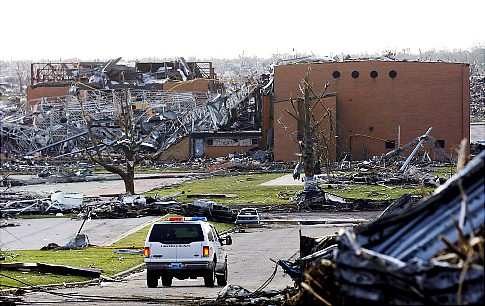
Joplin High School

My high school, only about one mile west of my old house, was destroyed. About half a mile west of my house, only wreckage of a large grocery store remains. Mangled cars lay on their sides or in piles in the parking lot. Another half a mile to the east of my house is Range Line, Hwy 71, packed with businesses. The roof of Wal-Mart is gone. Home Depot leveled. Academy Sports in shambles.
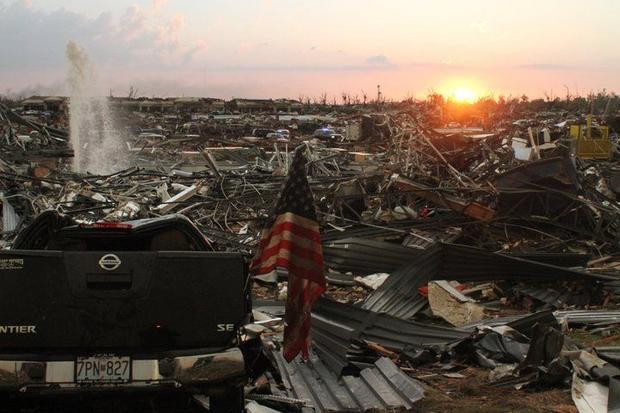
A barren horizon in Joplin

The horizon presents an eerie scene. Instead of houses, piles of rubble and debris litter the landscape. Only the trunks of most trees protrude out of the ground, limbs gone, bark stripped away. But why is the sky so clear and bare looking? All of the power lines and poles lie on the ground, leaving an unobstructed view of the horizon.

St. John's Hospital

A regional hospital suffered as an early victim of the twister. Only the structural ironwork of the top two of its nine floors remains. Nearly every window in the building imploded, spraying patients and staff with broken glass. One hundred and eighty patients were evacuated to a nearby hospital.

Academy Sports on Range Line

Search and rescue operations continue today, greatly hampered by more inclement weather. The death toll continues to rise as I write, now at 123. Rescue workers must travel from house to house and upended car to smashed car, looking for occupants. Thousands of people are now displaced and must find alternative housing. Most of them have only the clothes they wear and their lives.

Joplin Wal-Mart on Range Line

Seeing the devastating pictures of a town where I lived, of places where I shopped, of buildings I often visited, of homes that I passed daily, brings the losses much closer. I cannot remain as detached as I might when looking at tornado damage in Birmingham or Tuscaloosa. These houses and buildings were – are – part of my life.

Home Depot was a site of seven fatalities

I can more easily envision surviving the sheer horror of the tornado, only to crawl out from under the furniture, the two-by-fours, the bricks, the drywall and the insulation to find my roof and walls gone. I can imagine looking at my neighbors’ houses – what is left of them – up and down the block. Where will I take my family to sleep tonight? What about next week? Where will my children go to school – next year? Where will I buy the things I need – food, clothing, contact lens cleaner? Where will I get money to pay for these things? Do I still have a job to go to? How can I rebuild my house financially?

Hundreds of previously unnecessary questions now entangle thousands of lives, punctuated with the nagging question, Why? Some people will invent answers to retain their sanity. Some people will discover correlations that can be explained dozens of other ways, but they will bring comfort. I ask myself if I would be able to declare with Job, “Naked I came from my mother’s womb, and naked shall I return. The Lord gave, and the Lord has taken away; blessed be the name of the Lord.” Job 1:21

Neighborhoods leveled by the tornado in Joplin

Ten years from now, some people will still suffer the effects of this traumatic night. Most will have rebuilt their homes, their businesses and their lives. Some may be affected by PTSD (post-traumatic stress disorder). But for most, they will have managed to move on, their memories indelibly marked by the panic of that Sunday night in May 2011 and the months of crisis that followed.

My old family house - 2104 Alabama

Central to their recovery will be their theological adjustments. How will they explain this tragedy? Is there any meaning or purpose to it? How can this nightmare benefit anyone? How is it possible for any good to emerge from this evil? Where is God in the midst of my disaster and chaos? Does he really care about me? I prayed, but my home is gone. Is he there?

These questions reveal the human soul in theological crisis. They are real. They are honest. They are authentic. They display the turmoil of life in distress, seeking reorientation to theological north.

Dorothy Sayers poignantly writes, “For whatever reason God chose to make man as he is – limited and suffering and subject to sorrows and death – He had the honesty and courage to take His own medicine. Whatever game He is playing with His creation, He has kept His own rules and played fair. He can exact nothing from man that He has not exacted from Himself. He has Himself gone through the whole of human experience, from the trivial irritations of family life and the cramping restrictions of hard work, and lack of money to the worst horrors of pain and humiliation, defeat, despair, and death. When He was a man, He played the man. He was born in poverty and died in disgrace and thought it well worthwhile.” (Christian Letters to a Post-Christian World, 1969, p 14)

God knows our suffering because he experienced it as a man. This does not answer all the questions, but it answers the important ones. God is there, and he loves us, and he is with us, and he will help us – blessed be the name of the Lord.

Posted in God and Nature, Natural Disasters, Suffering | Tagged , , , , , , , , , , , , | 1 Comment

EVERY NATION, EVERY PEOPLE, EVERY LANGUAGE

This past Sunday, over 200 people packed into our sanctuary to celebrate the 100-year anniversary of evangelical Christianity in Viet Nam. The First Vietnamese Alliance Church, renting our facilities, hosted the celebration.

Robert Jaffray

In 1887, a Presbyterian minister, A.B. Simpson, channeled his passion for reaching people who had not heard the gospel into the founding of the Christian and Missionary Alliance. Simpson’s preaching inspired many young believers to travel to foreign countries as missionaries. One of those people, R.A. Jaffray, a Canadian, fresh out of the New York Missionary Training School, moved to south China in 1897. The next year he made a visionary trip to scout out Viet Nam.

In 1911, Jaffray, along with P.M. Hosler and G.L. Hughes, purchased land in Da Nang and built the first Protestant missionary base in Viet Nam. In 1913, he set up a printing press in Hanoi to distribute tracts and Christian materials, and established the Touranne Bible School in Da Nang in 1918. He oversaw the planting of missionaries in each of Viet Nam’s major population centers, using Saigon as a base to launch missionary work into Cambodia in 1923.

By 1967, only about 150,000 Vietnamese, one percent of the population, had adopted the Christian faith. That number has ballooned to 1.5 million followers of Christ, due in large part to the house church movement. Many believers fled the country after the communists acquired South Viet Nam in 1975, settling in U.S. cities. The First Vietnamese Alliance Church descends from this legacy.

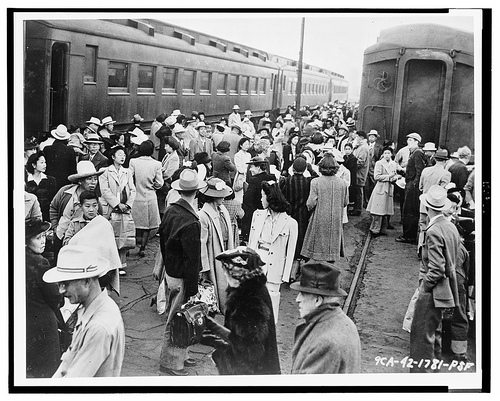
Japanese-Americans being relocated to internment camps

Next month, Lakeside Church of Chicago will celebrate its 68th anniversary. A Japanese-American doctor hosted a Bible study in his home in 1943, and invited a pastor from California to develop that group into a local church. Meeting in the basement of Moody Memorial Church, Lakeside Japanese Christian Church attracted several hundred Japanese-Americans, many who had recently moved to Chicago from internment camps.

The congregation has experienced several transitions in seven decades, adapting to different cultural and social contexts. The first major transition watched the Japanese-speaking congregation decrease from nearly 200 people to a smaller group, while the English-speaking congregation expanded in numbers. Leadership and vision had to change.

The church attracted people from other Asian ethnic groups, while maintaining its Japanese identity. Intermarriage occurred and bi-ethnic children were born. A move from the city to a very ethnically diverse suburb resulted in more changes to its ethnic composition. Only about 35% of the congregation now has a pure Japanese descent.

The first missionary to Japan, Dr. James Hepburn, opened a medical clinic near Tokyo in 1859. His Christian influence continued for 23 years. Divie McCartee, a Presbyterian minister, went to Japan in 1861 and began evangelistic work. The Japanese have never received the gospel on a wide scale, and today, only about 0.5 percent of the population claim faith in Christ.

These ethnically diverse churches, First Vietnamese Alliance Church and Lakeside Church of Chicago, demonstrate the power of a message that was birthed 2000 years ago in an occupied country. When Jesus died, only a few hundred people identified themselves as his disciples. Before his crucifixion, Jesus made it crystal clear that those disciples had the responsibility of taking that message to every nation of the world.

The gospel of God’s kingdom has a universal scope. The Church of Jesus Christ possesses no ethnic or racial borders. Language or cultural impediments do not alter the mandate to take this message of forgiveness and reconciliation to every people group that lives on earth.

When the apostle John was permitted a brief vision into heaven he saw “a great multitude that no one could number, from every nation, from all tribes and peoples and languages, standing before the throne and before the Lamb” (Revelation 7:9). The gospel is like a prairie fire, spread by the wind of the Holy Spirit, which “blows where it wishes” (John 3:8). Nothing will stop it, not even the gates of hell (Matthew 16:18).

The American imperialistic affinity sometimes blurs our vision. We forget that America was not the final destination of the gospel. We forget that the New Jerusalem is not located in the West. We forget that Americans are not the ruling class in the kingdom of God. We forget that Jesus’ words to his disciples on that mountain in Galilee are no less directed to us, “Go therefore and make disciples of all nations …” (Matthew 28:19).

We are heralds in a long line of heralds, which includes A.B. Simpson, R.A. Jaffray, Dr. James Hepburn and Divie McCartee. We declare a message from the King and for the King. We deliver the good news of the kingdom, a multiethnic kingdom, a kingdom without borders. We offer a message of peace that can conciliate the national and racial hostilities in this world. We unite with those from every nation, every people and every language to announce one message with one voice: “Salvation belongs to our God who sits on the throne, and to the Lamb!” (Revelation 7:10)

Posted in Mission, The Church - the Body of Christ | Tagged , , , , , , , , , | Leave a comment

UNMASKING MULTICULTURALISM

Zaineb Chaudhary

Zaineb Chaudhary did not come home from school one Friday and her parents reported her missing. The 16-year-old girl contacted friends through her cell phone the next day, but then went silent. Nearly six weeks later, authorities found her safe and unharmed.

Although the media cannot release specific details about her disappearance because she is a juvenile, most people believe she was trying to avoid an arranged marriage. Chaudhary’s father returned to the family’s home country of Pakistan in October to arrange a marriage. Chaudhary apparently did not approve of the arrangement.

Nearly a week before Chaudhary’s disappearance, 13-year-old Jessie Benderwas discovered living in a motel in California, missing from her home for over a week. Her parents initially said she ran away to avoid a

13-year-old Jessie Bender

two-month family trip to Pakistan, home of Bender’s stepfather. They later changed the story, saying they believed she had been abducted by a Chicago man she knew through Facebook.

Bender told police that her stepfather was taking her to Pakistan to force her into an arranged marriage. A relative helped her flee her home, securing a motel room for her miles away.  Authorities took Bender and her three siblings from their home while investigations continue.

Incidences like these puncture the inflated opinions about multiculturalism. Arranged marriages are officially sanctioned in Pakistan. Both men were doing nothing wrong according to their cultural standards. The cultural practice emerges from a cultural value that depreciates women and restricts their rights.

For decades, political advocates have praised and promoted multiculturalism, arguing for the social benefit of interaction between differing cultures. Cultural relativism grew out of this position, treating all cultures as equal and morally neutral. Some people advocate preserving the coexistence of cultural distinctions rather than promoting assimilation into a single culture, calling it a salad bowl rather than a melting pot.

Some practices and traits of a culture may exist independently from particular values, such as food or dress. But many cultural practices are rooted in values and very often, religious beliefs. Adherents treat the practice with moral assertion, as the right thing to do and competing practices as wrong.

Protests in France over the wearing of the hijab

Multiculturalism suffered a severe blow in 1989 in France, when three Muslim girls were expelled from middle school because they would not remove their hijabs, the head covering for Muslim females. The minister of education supported the administrator. A few months later three more girls were suspended for the same reason. This led to student-led demonstrations. Over 100 girls were suspended between 1994 and 2003, but nearly all of them were reinstated by French courts.

The traditional Muslim scarves conflict with two French values. The French interpret the hijsb to represent female submission to men. Taking pride in the equality they have built into their society, they do not want to risk challenging this social standard by a male-dominant religious or ethnic group.

Young woman wearing a hijab

Second, the French promote unity throughout society, taking a strict posture for the separation of church and state. The French government has stated that wearing any clothing in public schools that clearly identifies someone with a religious affiliation subverts the desirable secularism. In 2003, President Chirac extended the policy forbidding the display of the hijab in public schools to secondary schools, jeopardizing the delicate peace between religious communities in France.

Arranged marriages present a similar problem for the U.S. Forced marriages would violate human rights standards in this country. When the state stepped in to take the Bender children into protective custody, it implied a value judgment on the practice. These two cultures are on a collision course and one will have to give way to the other.

Diversity may expand a person’s perspective of life and the world that we share with many different peoples and cultures. This does not mean that all cultures are equal. Values are embedded in many cultural habits. And values have moral weight, exposing every culture to moral critique. Competing cultures will need to dialogue and find ways to resolve value conflicts, because the ruling government legislates laws that protect the established values.

Historically, Christian values have come into conflict with the dominant cultural values, causing governing authorities to resolve the conflict. Very often, the authorities have pressured Christian communities to compromise or forfeit their values. Believing that God had mandated the questioned value, they chose to cling to it. In many countries this brought persecution. Lions dined on Christians in Rome’s Coliseum. Protestant Christians were incinerated by European governments in the Middle Ages because they taught doctrines that embarrassed rulers. Our own country was settled by many who were driven from their home countries in a cultural clash.

Values and beliefs require evaluation. They cannot hide behind appeals to multiculturalism, demanding immunity from criticism. Christians must not only refuse to compromise biblically informed values, but we must also enter into the dialogue of critique. If we hesitate too long, we may find ourselves in a vulnerable minority.

Posted in Culture, Multiculturalism | Tagged , , , , , , , , , | Leave a comment

JUSTICE WILL BE DONE

The headline on Monday morning read in large bold print, “U.S. KILLS BIN LADEN.” Under the headline, the subtext read, “Obama: ‘Justice has been done.’” The large picture of the world’s most-wanted man presents a stark contrast to the heinous terrorist plots associated with him and his extremist Muslim organization, al-Qaida.

Since identifying him as the prime suspect in the 9/11 attacks on the World Trade Center and the Pentagon, the U.S. has devoted major resources to a sophisticated manhunt for his capture. The U.S. government had offered a $25 million reward for his apprehension or conviction. Government intelligence agencies all over the world have been looking for this man, but he somehow managed to elude them for almost ten years.

Compound in Abbottabad, Pakistan where Osama bin Laden was killed

Sunday, May 1, following months of extensive intelligence work on a lead, a U.S. Navy SEAL special ops team assaulted a mansion where bin Laden was living, killing him and four other people. Many believed he had been hiding in the rugged terrain in Pakistan’s western region near the border of Afghanistan. Instead, he was occupying a luxurious residence in the resort city of Abbottabad, home to over 500,000 people and just 30 miles north of Pakistan’s capital.

Former president, George W. Bush, issued a statement, “The fight against terror goes on, but tonight, America has sent an unmistakable message: No matter how long it takes, justice will be done.”

Not everyone would agree with Mr. Bush. His statement proved true in this case. But even with the most sophisticated intelligence agencies in the world working to find this fugitive, justice was delayed nearly a decade. His statement might serve as the tag line for scripted television shows like “Cold Case” and “Bones,” but it rings hollow in neighborhoods like Chicago’s south side.

The African-American community would likely dispute Mr. Bush’s assertion. Although a civil war secured the freedom for slaves, Jim Crow laws restrained our black neighbors from achieving social or economic justice for nearly a century. When the U.S. finally outlawed segregation, black Americans were so disenfranchised and entrenched in poverty that they were excluded from any hope of pursuing the American dream. When will justice be done for them?

Presidents have a knack for using rhetoric that appeals to our inflated egos. Americans love our justice and in many ways, no country in the world comes close to the standard of justice in America’s juridical tradition. A sense of justice runs deep in the American psyche, as evidenced by the number of television series devoted to the subject.

But justice has a broader scope than simply catching and prosecuting criminals. Something that is just is “guided by truth, reason, justice, and fairness.” (Dictionary.com) Are African American children receiving a fair education, given the disadvantages that plague their families and communities? Are unregistered immigrants being treated according to reason or according to legal statutes only? Are America’s law really just or merely favorable to the economic advantages of those already well off?

The U.S. spent millions of dollars to bring one man to justice. How does that offset the injustice of the financial neglect of urban school systems? Our government can justify spending $664 billion on the military by declaring it is in the interests of every American citizen to preserve our freedoms. Will that satisfy the million children who go to bed hungry tonight as a reasonable (and just) use of resources?

Mr. Bush’s statement indirectly does prove to be true on another level. Israel’s king, David, wrote, “I know that the Lord will maintain the cause of the afflicted, and will execute justice for the needy.” (Psalm 140:12) Yet, his son, the wise Solomon, wrote, “If you see in a province the oppression of the poor and the violation of justice and righteousness, do not be amazed at the matter ….” (Ecclesiastes 5:8) Solomon observed that the Lord does not execute his justice immediately. The wicked prosper, for a very long time sometimes, and the oppressed suffer, for an equally long time. The poor die in their poverty and the afflicted die without just retribution.

But God will execute his justice in his time. The Bible presents a picture of life that transcends our brief existence on this planet. Someday we will look back on our current tenure with marvel at its brevity. What may seem interminably long now will be remembered as a meteoric streak across the sky.

By my junior year in high school, I could not wait to leave home and my hometown and go to the big university. Forty-four years later that time of oppressive duration seems like a tick of the second hand on the clock. In fact, my five and one-half years of college (extended stay) occupy only memories now, which fade with each passing year.

“No matter how long it takes, [Gods’] justice will be done.” And I believe many will be quite surprised by the display of that justice when he performs it.

Posted in Hope, Justice | Tagged , , , , , , , , , , , | Leave a comment

REASONABLE FAITH

Doubting Thomas. What a nickname to be saddled with. A close follower of Jesus, chosen by Jesus to be one of the Twelve, those who would have closest access to the Rabbi, to his miracles and his teachings. Yet, he was so disillusioned by the crucifixion of this man whom they were so sure was the Messiah that he refused to believe in his resurrection, even when ten of the Twelve testified that they had witnessed it with their own eyes. Thomas – a true skeptic. Then Jesus appeared to him.

Thomas stands in a long line of converted skeptics. Saul of Tarsus was a young Pharisee, full of passionate zeal for the law of the Jews. He detested the early Christians as the patriot detests the traitor. He was so convinced that Jesus was a false prophet and his followers were spreading blasphemies that he hunted them down like animals, going from house to house to find them and drag them to prison. Then Jesus appeared to him and he became Paul, the apostle of Jesus Christ.

C.S. Lewis

C.S. Lewis stood out among his peers as a true intellectual genius. He began teaching English at Magdalen College, Oxford when he was only 27. He had made a conscious and reasoned decision to become an atheist at age 15. He could not see any rational logic for the existence of a God – until Jesus appeared to him.

While studying in the English School in his fourth year at Oxford, he encountered another student who stood out among the rest, Nevil Coghill was “clearly the most intelligent and best-informed man in that class.” To Lewis’ shock, Coghill was also a Christian.

Of the copious books he was reading, a strange feature kept repeating itself. The best written books and the most interesting authors were also Christians: George MacDonald, G.K. Chesterton, Edmund Spenser, John Milton and others. It was the most religious authors upon whom “I could really feed,” while those “who did not suffer from religion … “seemed a little thin…. There seemed to be no depth in them. They were too simple. The roughness and density of life did not appear in their books.”

Of his conversion, Lewis writes, “In the Trinity Term of 1929 I gave in, and admitted that God was God, and knelt and prayed: perhaps, that night, the most dejected and reluctant convert in all England. I did not then see what is now the most shining obvious thing; the Divine humility which will accept a convert even on such terms. The Prodigal Son at least walked home on his own feet. But who can duly adore that Love which will open the high gates to a prodigal who is brought in kicking, struggling, resentful, and darting his eyes in every direction for a chance of escape?” (Surprised By Joy) Over the course of the next two years, Lewis moved from theist to Christian. Lewis’ book, Mere Christianity, has provided one of the best presentations of the Christian faith written in the last 70 years.

Lee Strobel

Lee Strobel knew from childhood that he wanted to be a reporter. He went to one of the best journalist schools in the country and followed it with a Master of Studies in Law from Yale. He landed a job with the Chicago Tribune at a young age.

Strobel was unscrupulous as an investigative reporter and ruthless as a colleague. He once had a fellow reporter fired from his job who was on his honeymoon when he got the call. He had no use for religion or God. His moral base only served his selfish interests. Then Jesus appeared to him.

One day his wife announced she had become a follower of Christ. Strobel believed it was the worst thing that could happen to their marriage. He told her that she could give no money to the church, because that is all they wanted, and that he would never go with her, “because I’m too smart for that.”

For the next few years, the stress of their religious disparity nearly destroyed their marriage, but Strobel could not complain about the positive changes in his wife’s life. Occasionally she invited him to church, but he refused. Finally, one day he went and was not turned off. He decided to use his legal and investigative skills to examine and disprove the Christian faith. After nearly two years of critical scrutiny he conceded to the evidence and trusted in Christ.

Strobel wrote two books that presents the evidence with integrity and persuasion: The Case For Christ (1998) and The Case For Faith (2000). He served on staff at Willow Creek Community Church and now is a teaching pastor at Saddleback Valley Community Church in California.

Josh McDowell

Stories abound of similar conversions, like Josh McDowell, who invested 700 hours in trying to disprove the Bible and the resurrection story, but finally decided the evidence was overwhelming. McDowell has been one of the leading speakers on campuses over the last 50 years for Campus Crusade for Christ. To millions of skeptics over the centuries, Christianity became rational, even reasonable. For them, faith was not a blind leap into an unknown darkness after shedding the harness of the mind and the parachute of reason. At some point, Jesus appeared to them and they could no longer argue with the evidence.

God is not frightened by the doubts, the defiance, the arrogance of the skeptic. There is a “Love which will open the high gates to a prodigal who is brought in kicking, struggling, resentful, and darting his eyes in every direction for a chance of escape.”

Posted in Faith and Reason | Tagged , , , , , , , , , , , , | Leave a comment