THE CHURCH IS IN TROUBLE

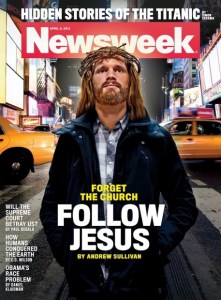
church 1“Christianity itself is in crisis.” This is Andrew Sullivan’s assessment in his Newsweek article, “The Forgotten Jesus” (April 9 2012). The article received cover status with the lead-in declaring, “Forget the Church – Follow Jesus.”

Sullivan accurately identifies the co-opting of Christianity by the culture. He chides the Catholic Church for its failure to deal with the sex scandals with transparency and integrity. He criticizes the politicization of Christianity, as identity in the faith now equals identity with a narrow political platform. He rejects the prosperity gospel preached from the pulpits of megachurches converted from sports arenas.

Sullivan begins his article with Thomas Jefferson’s Bible. Only 27 years old, Jefferson audaciously revised the Bible, particularly the Gospels. He cut out the sayings of Jesus that he believed comprised the “very words of Jesus” and pasted them into a slim book. Everything he left he deemed inventions of his followers, including all the supernatural claims.

The Bible after Thomas Jefferson's redactions

The Bible after Thomas Jefferson’s redactions

It was Jefferson who articulated the separation between church and state. Not only did he wish to protect the Church from political trespassers and usurpers, but he also hoped to preserve the republic from zealous religious conquistadors. For him, Christianity needed to be purged of any political overtones, since politics ultimately requires power over others. “Above all: give up power over others, because power, if it is to be effective, ultimately requires the threat of violence, and violence is incompatible with the total acceptance and love of all other human beings that is at the sacred heart of Jesus’ teaching,” writes Sullivan of Jefferson.

Although Sullivan would not agree with his theology, he calls Jefferson’s point “crucially important.” He sides with the apolitical version of Jesus and Christianity.

“What is politics if not a dangerous temptation toward controlling others rather than reforming oneself?”

Sullivan envisions a Christian voice that can “be faithful in a religious space and reasonable in a political one.”
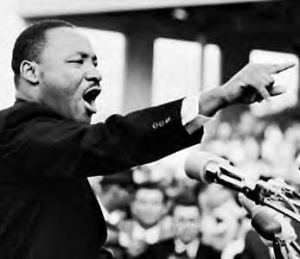
Martin Luther King Jr. when he declared, "I have a dream." (AP)

Martin Luther King Jr. when he declared, “I have a dream.” (AP)

Those who would silence the religious voice in politics also memorialize people like Martin Luther King Jr. and Abraham Lincoln for their efforts to rid the republic of social injustices. Yet, their sense of justice was informed and shaped by deep religious beliefs and those beliefs punctuated their rhetoric. Even if politicians purged their speeches of all religious language, could they segregate their convictions from their religious beliefs?

Sullivan does not require that. In fact, he does not advocate a privatized faith or sterilized politics. He agrees that the Church should mobilize in the face of social injustices. His heroes include Ghandi and King, those who embraced nonviolence. Although they resisted political power for themselves, they believed power came through principled conviction that did not prostitute itself with the strategies of power brokers.

“When politics is necessary, as it is, the kind of Christianity I am describing seeks always to translate religious truths into reasoned, secular arguments that can appeal to those of other faiths and none at all. But it also means, at times, renouncing Caesar in favor of the Christ…. [This Christianity] may, in fact, be the only spiritual transformation that can in the end transcend the nagging emptiness of our late-capitalist lives, or the cult of distracting contemporaneity, or the threat of apocalyptic war where Jesus once walked.”

church 4Maybe Sullivan is on to something. He is not the first to raise these concerns, but he did it with finesse in a major publication. Many Christians are tiring of public declarations of religious fidelity by politicians who then implement barbaric methods of torture for extracting information in the name of national security. Somehow, I cannot see Jesus signing off on this.

Sullivan does not denounce the Church as Jesus instituted it. He decries the cheap imitation that has resulted from the plastic surgery of 21st Century politics and culture. He calls for a reformation of the Church, a purification of the body of Christ, a return to the meek and humble Jesus of the Bible, the Jesus who did not wield power over people, but used it for people.

Jesus called his followers to permeate every nation with the message of his kingdom. Regardless of what political system governs a nation, it cannot suppress this message of forgiveness, reconciliation and love. Two millennia of history verify that.

Jesus’ kingdom is not of this world, nor should it look anything like it. Sullivan believes that the Church is compromising that kingdom and its message. He is not promoting a Jeffersonian revision of the Bible, but calling the Church to examine itself in the light of the Bible, especially in the presence of Jesus.

Posted in Politics and Christianity | Tagged , , , , | Leave a comment

IS UNITY POSSIBLE FOR THE THREE MAJOR RELIGIONS?

unity 1When I walked into my yoga class this morning, the instructor and another lady were talking about attending church on Easter. One lady said that the preacher gave a sermon showing the similarities of Christianity, Judaism and Islam. He explained that all three are monotheistic and recognize the Abrahamic covenant.

I think his message argued for a basis of some form of unity, because the instructor chimed in with her opinion. She does not like the “segregation” of the religions and believes we should find a way to unite.

I wanted to ask, What kind of unity do you think is possible with these three religions? These intelligent women seemed to ignore the distinctions of each religious system that set each apart from other religions. These distinctions necessarily “segregate” each system in the sense that they explain why each religion needs to exist.

The call for a unity of Judaism, Christianity and Islam demands that each system deny its distinguishing doctrines. Islam would have to deny that Ishmael was the intended recipient of God’s covenant promises to Abraham. Judaism would have to deny that Isaac was the chosen seed. They would have to agree that descending from Abraham is all that matters. Then they would both have to accept that God also determined that others could become recipients of the promise through the same kind of faith that Abraham possessed, as much of Christianity believes.

Christianity would have to deny the deity of Jesus, the unique personhood of the Holy Spirit, the resurrection of Jesus and God’s offer of forgiveness to man through the work of Jesus on the cross, to name only a few doctrines. Islam would have to deny that God called Muhammad as a prophet. Judaism would need to abandon most of their holy days.

unity 2The mutilation of these three systems would leave nothing that even remotely resembles the originals. The character of God and the moral nature of the universe would remain, although the means of obtaining God’s forgiveness and acceptance would demand discussion, since the three systems disagree on this doctrine. Agreement on much of history would survive (except for the resurrection of Jesus), but interpretation of events would require negotiation.

As you can see, a few similarities do not provide a foundation for unity. Unity necessitates agreement, which could never evolve out of these divergent belief systems.

Every religion contains a set of beliefs that define it uniquely from other religions. Otherwise, it would have no reason to exist. Calling for unity asks people to jettison their beliefs for no rational, evidential reason, which seems naïve at best.

unity 3Many people suggest we need tolerance, an unbiased acceptance of each other with all of our differences. This tolerance would need to allow for a free discourse of ideas and beliefs. Each religion poses as the correct system. If the pursuit of truth is not compromised by this tolerance, then every human should be granted the freedom to seek this truth through careful investigation of each religion.

Fanatics of all three religions have sabotaged a peaceful coexistence throughout history. This fanaticism does not fairly characterize any of the religions. Debate surrounds Islamic teaching on jihad, but if we accept the dominant teaching, jihad should not disrupt true tolerance.

Christianity should distinguish itself from the other two in this respect. All three systems require a habit of love. But Jesus commanded a higher calling when he instructed his disciples to “love your enemies.” Adherents of other religions are not inherently our enemies, since a difference of opinion does not constitute enmity. Followers of Christ are compelled to practice an active love toward every person we know. We have no excuse for creating an atmosphere of superiority or hostility or strife.

Fanatics who choose to attack Christians in the name of their religious beliefs make themselves our enemies. According to Jesus, we should extend the same love and acceptance to them as to any other neighbor. This does not preclude the need for justice or a respect for and protection of life. The offer and practice of this kind of love is complex, but still necessary, if we want to practice our belief system with integrity.

unity 4Paul identified Jesus’ followers as his ambassadors. Jesus did not retaliate against his enemies. He did not strike back against those who struck him. He did not even revile those who made themselves his enemies. In the midst of intense pain caused by his accusers, he prayed to his Father to forgive them.

This kind of love should identify Christianity. Others may advocate for love in their systems as well, but I do not believe they take love to this degree.

Not only should we not concede to the cries for unity with other religions, but neither should we compromise a love that was projected onto all people from the cross.

Posted in Christianity and Judaism, Christians and Muslims | Tagged , , , , | Leave a comment

“THE HUNGER GAMES” AS A MIRROR

hunger 1Okay, so I have neither seen the movie nor read the book – yet. That will not stop me from commenting on the latest box office “blockbuster that doesn’t seem like a blockbuster,” The Hunger Games. Suzanne Collins wrote the young-adult trilogy and collaborated with director Gary Ross to adapt it for the screen.

Collins offers the readers/viewers “a terrible kind of mirror,” according to Jennifer Lawrence, who plays the teenage leading role, Katniss. “This is what our society could be like if we become desensitized to trauma and to each other’s pain,” said Lawrence. The book/movie tackles subjects like totalitarian government, invasive media and dehumanization.

The post-apocalyptic society remaining in North America has been divided into 12 districts. A failed revolution by dissidents resulted in the creation of the Hunger Games, used by the Capitol to suppress future uprisings and to entertain the “true citizens.” A teenage boy and girl are selected by lottery from each district for the televised reality show. The object of the game? Survival – of a different form than the current reality series, Survivor.

The 24 teens enter a forest where they must kill the other contestants. Only the last survivor wins the lifetime supply of food and privileges. The producers, at the wishes of governing authorities, can randomly inject complexities into the game with some ability to manipulate the outcome.

Katniss Everdeen

Katniss Everdeen

Some contestants train for years with the hope of selection. Katniss has learned her survival skills in her own reality of poverty. Her father has died and her mother has withdrawn mentally, leaving Katniss to fend for herself and younger sister. She hunts illegally in the woods outside her district’s perimeter just to put food on the table.

Names in the lottery are duplicated based on how many times they have had to appeal for government food subsidies. When Katniss’ sister, whose name appeared on only one slip of paper, is chosen, Katniss offers herself as a substitute. That courage and passion prove vital to her success in the game.

The idea of teens methodically murdering each other raises red flags. “What Suzanne has done brilliantly is create a series that is a critique of violence using violence to get that across, and that is a fine line,” said one of the book’s editors, David Levithan. The movie’s director, Gary Ross, explains that they have avoided all gratuitous violence without ignoring its reality in an effort “to be honest and capture the intensity of the book.”

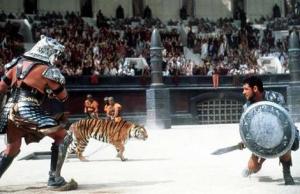
Gladiatorial games in Roman colosseum

Gladiatorial games in Roman colosseum

The Capitol has its roots in ancient Rome, where gladiators trained for regular arena combat for the entertainment of Roman citizens. The barbaric nature of watching warriors fight wild beasts or one another to the death defies any sensibility of a civilized society. A voyeuristic thirst for violence betrays a corruption of the human soul.

The modern Ultimate Fighting Championship (UFC) presents a tamer form of the Coliseum games. Trained in mixed martial arts, contestants engage in brutal unarmed combat. Watching one human beat another human senseless has become highly popular – and lucrative. How does this affect a society’s capacity for compassion and charity?

"The Bachelor" 2011

“The Bachelor” 2011

On a different front, one has to wonder what attracts audiences to so-called reality television. Manipulation and tawdry theatrics bleed through the contrived productions of many series. What kind of desperation leads a person to watch 25 women compete for the love of one man (The Bachelor)? What is entertaining about adults lying and deceiving one another in a remote location, in order to get contestants voted off (Survivor)? Isn’t American politics adequate?

The Hunger Games presents violence and death for what it really is: a curse on the human race. On one hand, we must learn to accept death as part of the natural cycle of life. The narrative of every creature’s earthly existence concludes with “The End.” On the other hand, our souls protest this unnatural cessation of life. Something horribly wrong infects the narrative.

Although we can learn to accept death as the way things are, we can never convince ourselves that it is the way things should be.

While humans are capable of violent behavior, this capacity seems more like a rabid virus unleashed in the human soul. Social laws punish the inhuman nature of harming another person or animal, even when it is unintentional. Yet, violent video games and movies gross billions of dollars every year, feeding on some repressed drive.

As a boy, I trained as a boxer at a local Boys Club. I competed for five years in the ring. One of my best memories as a teenager was sitting ringside with my dad at the Golden Gloves. But I never could get beyond that sickening feeling when I saw a boxer staggering on the canvass, battered and bleeding, a target for that final blow to the head.

The Hunger Games wants us to feel that horrifying revulsion of violence, that nauseating response to violent death, that heightened sensibility to the alien presence of these enemies of life. Although Collins may not be offering a religious answer to this subject, she certainly raises the questions for a religious discussion.

Posted in Death, Movies, Violence | Tagged , , , , , | 1 Comment

WHEN LOVE IS ABSENT

“We could have been having a critical discussion about the demons of cyberbullying and hate crimes, but we instead decided to flex our muscles and get tough. That’s not justice, for Mr. Ravi or for Clementi.” Jess Coleman, “Injustice at Rutgers,” The Huffington Post

An undated photo of Tyler Clementi at a family function (Clement family via AP)

An undated photo of Tyler Clementi at a family function (Clement family via AP)

On September 22, 2010, Tyler Clementi posted one last status on his Facebook page, “Jumping off the gw bridge, sorry.” That night he followed through with his announcement and jumped to his death in the Hudson River from the George Washington Bridge.

The tragedy drew national attention because Clementi was homosexual and was cyberbullied by his roommate, Dharun Ravi. Officials decided to prosecute Ravi on 15 counts, including bias intimidation, a basis for a hate crime. Last week, a jury convicted Ravi on all 15 counts.

Clementi and Ravi were randomly placed together as roommates in their freshman year at Rutgers. Clear differences established relational tensions. Ravi took advantage of Clementi’s social awkwardness. When Clementi asked Ravi to vacate the room until midnight so that he could have a guest, Ravi positioned his webcam for spying on the roommate while absent. Later he posted on Twitter, “Roommate asked for the room till midnight. I went into molly’s room and turned on my webcam. I saw him making out with a dude. Yay.”

Dharun Ravi escorted by his father as they leave court on March 16 (Mel Evans/AP)

Dharun Ravi escorted by his father as they leave court on March 16 (Mel Evans/AP)

Two days later, Sept. 21, Clementi again asked for the room until midnight. Ravi tweeted that he intended to set up a webcam viewing of the tryst, although there was no evidence that he or anyone else turned on the webcam that night.

On that same day, Clementi apparently learned about Ravi’s spying. He reviewed Ravi’s Twitter 38 times over two days. He talked to the dorm’s resident assistant about Ravi’s harassment and submitted a room-change request. The incident seriously disturbed Clementi. One day later, he committed suicide.

Ravi’s defense attorney did not dispute the facts in the case. The case pivoted on motives and perceptions. Witnesses for the defense testified that Ravi had never made any disparaging comments about homosexuals in general or about Clementi’s orientation, only that he felt uneasy rooming with a gay student.

Ravi listens to testimony by Molly Wei with text messages between them displayed on a screen. (Mark Dye/Reuters)

Ravi listens to testimony by Molly Wei with text messages between them displayed on a screen. (Mark Dye/Reuters)

To convict Ravi of bias intimidation, the prosecution had to prove that Ravi’s behavior was motivated by prejudice against homosexuality. Sexual orientation is a protected class under hate crime legislation along with race and gender. The complexity of the issue required the judge to instruct the jury for an hour.

The state did not charge Ravi for Clementi’s death nor was his death allowed as a factor during the trial. Only his action to video Clementi and use it for harassment applied. When the motive involves prejudice against a protected class, the hate crime law carries much more severe penalties than a conviction for bullying or harassment. Bias intimidation could draw a penalty of 10 years in prison. The judge will not sentence Ravi until May 21.

Everyone agrees that Clementi’s death was a tragic climax to very bad behavior, but many are debating the justice of the case. Had Clementi’s guest been a woman rather than a man, would it have attracted prosecution? Will a prison sentence appropriately punish Ravi’s actions? Should some classes of people be protected more than other classes by hate crime laws?

Questions abound about the justice of hate crime laws and the application of such to this case. But we should applaud the growing intolerance of bullying in any form. For too long we have accepted bullying as childish behavior, even in adults. Why have we not addressed it as a moral issue, like stealing or lying?

In moral terms, bullying must qualify as conduct contrary to love. Conduct contrary to love must be defined as a form of hate. Hate crime laws do not go far enough, because they restrict the definition to a few protected classes. Any action aimed to hurt another person physically or emotionally describes an act of hate.

Love Is Louder campaign to eradicate bullying

Love Is Louder campaign to eradicate bullying

Justice defines the penalties for violations of the laws formally enacted by legislation. If no law exists, no penalty can be exacted. Anti-bullying legislation moves closer towards the moral principle established by the Old Testament and reiterated by Jesus, “Love your neighbor as yourself.” All behavior should be judged by this immutable and comprehensive principle of love.

Parents should train their children from an early age that privilege does not define superiority, but responsibility. Having more than others (more wealth, more strength, more power) obligates a person to use that privilege in love, to provide for and protect those who lack the privilege.

How differently would our society look if biblical morality were applied. Critics often cite the severity of Old Testament penalties, but they must be interpreted in the context of the entire biblical text.

Jesus lived out justice in the context of love, and he always extended compassion and generosity to the outcast, to the underdog, to the weak. Jesus condemned those who did not protect the widow or the orphan and who used privilege to elevate themselves over others.

Kingdom law can be summarized by this principle of love. Kingdom citizens should be identified by their consistent practice of love, not just in words, but in deeds. Every follower of Christ makes a kingdom impact on society when we live out this principle daily.

Posted in Bullying, Hate Crimes, Justice, Love | Tagged , , , | Leave a comment

BEAUTY FROM ASHES

Residents pray at the school in Ishinomaki, Japan where 84 children and staff were killed in the tsunami, March 11, 2011

Residents pray at the school in Ishinomaki, Japan where 84 children and staff were killed in the tsunami, March 11, 2011

At 2:46 P.M. on Sunday, March 11, horns sounded across the entire island nation of Japan. People everywhere stopped and bowed their heads in a minute of silence. Special ceremonies throughout the country commemorated the devastating disaster that occurred at the same time one year ago.

The disaster came in three waves. The first wave, an earthquake measured at 9.0, the largest in Japan’s history, shook the northeast of Japan violently. Although quite familiar with earthquakes, Japanese communities witnessed excessive damage.

The second wave, a giant tsunami, first reached the coast in less than 30 minutes after the earthquake hit. The wall of water, peaking at 133 ft. in one location, carried boats, cars and houses inland, as far as six miles. It left over one million buildings partially damaged or completely collapsed.

Fukushima Daiichi nuclear power plant remains damaged after one year (Issei Kato/APP/Getty Images)

Fukushima Daiichi nuclear power plant remains damaged after one year (Issei Kato/APP/Getty Images)

The third wave resulted from the first two. The eleven reactors of the Fukushima Daiichi Nuclear Power Plant automatically shut down with the earthquake. The tsunami overflowed into the plant, drowning emergency backup power systems. Radioactive rods began a meltdown process that leaked radiation into the surrounding region. Official had to evacuate over 200,000 people surrounding the plant.

The death toll soared to 15,854, with 3,155 people still missing. Early estimates calculated over 500,000 people displaced, with 340,000 still homeless today. Crews have removed nearly 25 million tons of rubble, leaving hundreds of square miles of empty land. Reconstruction has begun, but it will take many years before the affected communities recover. Some never will.

Mountains of debris from the tsunami collected in one location

Mountains of debris from the tsunami collected in one location

Natural disasters of this magnitude create theological upheaval, especially for those who already seriously doubt the existence of a benevolent God. They refuse to accept any theistic explanation for this kind of human tragedy. They can only see unnecessary and undeserved human suffering.

Science can explain the disorder with its laws of physics. These laws resulted from years of careful observation and calculation. They cannot explain anything like origin or purpose, however. Christian theology would never deny the explanations of good science. And good theology would never try to give more explanation to the causes of the disorder than what God reveals.

Accepting that God has revealed himself in the Bible, Christian theology argues that natural disasters are really unnatural. God originally created the universe with a harmony that would never allow destructive forces to oppose human existence. He placed humans in that paradise with the authority and ability to rule over the creation, giving order to natural forces for further creation and reproduction.

The isolated houses left on Ishinomaki's sea front

The isolated houses left on Ishinomaki’s sea front

The humans upset the equilibrium by rejecting God’s authority and disobeying his command. When sin entered the world, its devastating effects reached beyond humans. God placed the entire creation under a curse as part of the penalty for the humans’ disobedience. This curse violently disrupted the harmony of the creation, leaving it subject to destructive forces.

The apostle Paul describes the unnatural disorder this way, “For the creation waits with eager longing for the revealing of the sons of God. For the creation was subjected to futility, not willingly, but because of him who subjected it, in hope that the creation itself will be set free from its bondage to corruption … For we know that the whole creation has been groaning together in the pains of childbirth until now.” Romans 8:22

Some natural disasters in history have served as a specific divine punishment. The plagues on Egypt recorded in Exodus, for example, resulted from Pharaoh’s refusal to obey God’s demand to let Israel leave Egypt. The concentration of these disasters suggests direct intervention by God to cause the plagues, using scientific laws. Through the plagues, God demonstrated his authority over Pharaoh and his superiority over Egypt’s gods.

We can confidently assert this explanation because God revealed the cause and purpose to Moses. Science could offer no help in this explanation. Whether one believes that Moses provided an accurate interpretation of his experiences, and the record of his interpretation has survived several millennia is another matter.

The wall of water flooding into Japan on March 11, 2011 (Newscom/Kyodo/WENN.com)

The wall of water flooding into Japan on March 11, 2011 (Reuters)

Good Christian theology will not try to overstep God’s revelation and suggest cause or purpose that God has reserved for himself. Why God allowed Japan to suffer such horrific tragedy we cannot answer. But we can affirm that nothing in the universe happens apart from his sovereign and good purposes. (“For from him and through him and to him are all things.” Romans 11:36)

Japan’s devastation somehow fits into the purposes of God. God is not only benevolent, but he is also holy and just (also revealed in the Bible). And he can create beauty out of ashes. He can make all things, even earthquakes and tsunamis, work together for good for those who know and trust him (Romans 8:28). It is up to each person in Japan, through faith, to discover the good that God intended for him or her.

Posted in God and Nature, Natural Disasters, Sovereignty of God, Suffering | Tagged , , , | Leave a comment