THE DIFFERENCE A CAMERA CAN MAKE


Robert Adams outside Rolling Meadows Chase

Robert Adams became a media hero last month when the 54-year-old hospital engineer turned in a bag containing $17,021 to a bank. Craving a cold drink on a very hot day, Adams stopped at an ATM outside a Chase bank in Rolling Meadows, Ilinois. At the ATM, he looked down and noticed a clear plastic bag on the sidewalk. Closer inspection revealed the bag had receipts, checks and cash bundled in a rubber band.

Adams immediately took the bag inside the bank, suggesting that an employee may have left it accidentally. Employees told him that the bag could not belong to the bank because the machine is filled from the inside. This led to further investigation.

Adams claimed that he never even considered keeping the money. “It’s not my money. I shouldn’t take it. I don’t care if you put another zero on there, I wasn’t raised to take money that isn’t mine.”

That was his story on June 9. The investigation uncovered a different story, which Adams later sheepishly verified.

Adams had traveled to Midlothian to meet someone who stood him up. Wanting something to drink, but short on cash, he stopped at an ATM inside a Walgreens. He reached down for something on the floor when he noticed the bag. He looked around, nonchalantly picked up the bag and walked out of the store.

Adams confessed, “I did have that thought in my mind (upon finding the money): ‘Yes, I could do a lot with that.’ I considered that to be the human reaction to seeing a large sum of money in front of me.”

On his drive home, Adams resisted the temptation to keep the money for himself. He pulled into the Rolling Meadows bank with his first story that he invented to conceal his initial response. Forty hours of investigation over the next three weeks revealed the truth.

What changed his mind? What enabled Adams to abort an act of larceny? He admitted that he realized video cameras had probably recorded him taking the bag of cash.

I am sure Robert Adams is a great guy. People who know him would probably attest to his integrity. But the fact remains that as he flirted with temptation he lied. He used deceit to present himself as an honest man, What honesty he did display resulted from an awareness that someone had already seen him take the money – a camera.

What would Adams have done twenty years ago before surveillance cameras were taping much of our public lives? Maybe other reasons would have bolstered his resolve to resist the temptation during that hour-long drive home. But what compelled him to a moral choice last month was the reality that someone had already seen his action, reducing the possibility of getting away with the crime.

Most people consider the success of a crime before they commit it. They take great precautions to avoid observation. Surveillance cameras interfere with undetected criminal activity. They discourage immoral conduct, but they will not eliminate it. Criminals must plan to neutralize the cameras when planning their crimes now.

But what if every crime had at least one witness who could not be avoided? What if it was impossible to escape detection, arrest and conviction of any crime committed, regardless of the sophistication of planning? What if the perfect crime was no more attainable than time travel?

In Psalm 139, David considered man’s proximity to God and he concluded that man could never hide anything from God. God sees everything we do. God hears everything we say. God knows everything we think. Man can never hide from God. “If I say, ‘Surely the darkness shall cover me, and the light about me be night,’ even the darkness is not dark to you; the night is bright as the day, for darkness is as light with you.”

Believing that God sees every move I make seriously inhibits immoral choices. Believing that God will eventually one day judge my every action dissuades illicit deeds. Recognizing that a perfect system of justice does exist and I am subject to it encourages a righteous life.

None of us can sit in judgment over Adams. We all possess the capacity for capitulating to temptation under the right circumstances. We all have used deceit as a personal tactic in some setting, even self-deceit.

But if you thought a camera was recording every choice you made, would it affect your choices?

Posted in Character, Virtue | Tagged , , , , , , , , | 3 Comments

A LESSON FROM IMPROV

Steve Carell, Paul Dinello, Stephen Colbert, David Razowsky at Second City 1993

Stephen Colbert did not disappoint the audience at Northwestern University’s 2011 graduation ceremony. Known for his remarkable wit and profound satire, Colbert (pronounced cole – BEAR) graduated from Northwestern in 1986 with a degree in theater arts.

After graduation he needed a job and a friend got him on at Second City, answering the phone and selling souvenirs. He discovered that employees could take free acting classes so he signed up for a class in improvisation. Demonstrating a special talent, he was hired with Second City’s touring company as an understudy to Steve Carell (Michael Scott on TV’s The Office).

Stephen Colbert (4th from left) with Jon Stewart (seated) and Steve Carell (far right)

Colbert later appeared on The Daily Show, a parody of the news media and politics. After eight years with the highly successful comedy show, he launched his own television show, The Colbert Report. He continued the satirical bent, targeting news broadcasting, particularly the personality talk shows. The show has received three Emmy nominations and has enjoyed enviable ratings.

Colbert kept the Northwestern audience laughing for 15 minutes of the 20-minute speech before turning to “some advice” for the graduating seniors. First, he explains how dreams can change. Life has its own path for us that sometimes ignores our dreams. “So whatever your dream is right now, if you don’t achieve it, you haven’t failed, and you’re not some loser. But just as importantly … if you do get your dream, you are not a winner.”

Colbert speaking at Northwestern University's 2011 graduation

He then provided a lesson from improv comedy that Jesus might have used had he been living in the 21st century.

“After I graduated from here, I moved down to Chicago and did improv. Now there are very few rules to improvisation, but one of the things I was taught early on is that you are not the most important person in the scene. Everybody else is. And if they are the most important people in the scene, you will naturally pay attention to them and serve them.

“But the good news is you’re in the scene too. So hopefully to them you’re the most important person and they will serve you. No one is leading, you’re all following the follower, serving the servant. You cannot win improv.

“And life is improvisation. You have no idea what’s going to happen next and you are mostly just [making things up] as you go along.

“And like improv, you cannot win your life, even when it might look like you are winning. For instance, I have my own show, which I love doing, full of very talented people who are eager and ready to serve me. And that is great, but at my best, I am serving them just as hard, and together we serve a common idea, in this case, the character Stephen Colbert, who, it’s clear, isn’t interested in serving anyone. And a sure sign that things are going well is that no one can remember whose ideas were whose or who should get credit for what jokes, though naturally I get credit for them all.”

Improvisation runs counter to our intuition. So did Jesus’ teaching. “But whoever would be great among you must be your servant, and whoever would be first among you must be slave of all.” (Mark 10:43-44) In the kingdom of God, leadership takes a very different profile than in the world’s kingdoms. Christ-shaped leaders do not look like world-shaped leaders.

Improv sketch at Second City

I sometimes wonder if we are overly obsessed with structuring the church to look like well-run corporate structures. The Church has certainly invested enough time and money in training for organizational success as the world defines it. Maybe that time would have been better spent sitting in a theater, studying the actors on the improv stage.

Jesus upended the typical leadership model when he offered a horticultural analogy. “I am the vine; you are the branches. Whoever abides in me and I in him, he it is that bears much fruit, for apart from me you can do nothing.” (John 15:5) He didn’t tell his disciples, “You will be the vines of my church, and those under you will be the branches.” Sorry, only one vine exists.

Paul undermined natural leadership structures with a biological model. “And [Christ] is the head of the body, the church.” (Col. 1:18) “Now you are the body of Christ and individually members of it.” (1 Cor. 12:27) There is only one head: Jesus. All the rest of us are equally members of his body, although we serve very different functions, according to our gifts.

Leadership surfaces as one of those gifts, “Having gifts that differ according to the grace given to us …; the one who leads ….” (Rom. 12:6,8) But if Jesus intended his body to mimic an improv stage rather than a corporate building, then leadership will wear very different clothes than what common models have conditioned us to expect.

Leaders provide invaluable contributions to the organization of any structure. Leaders differ according to the gifts Christ distributes to them, creating different styles of leadership. Toes will lead a church differently from noses. But every Christ-shaped leader will serve other servants, a strategy that explodes the expectations for leaders that most of us have adopted.

I wonder if Colbert has ever been invited to speak at a leadership conference.

Posted in Serving | Tagged , , , , , , , , , , , , , | Leave a comment

MISSING A GOOD PERFORMANCE

Recently my wife and I were sitting in the audience at a dance performance. (Not surprised, are you?) Across the aisle to our right, a group of boys chattered away as we awaited the lights to dim. Their ages ranged from 7 to 12 or so.

I made several observations about this androcentric aggregate of pre-adolescents. They occupied several rows with empty seats on either side and in front and behind them. They were located strategically away from the rest of the audience, as if they had arrived as an identifiable association, like Boy Scouts or a Little League team.

No adults were sitting among them or near them. They had congregated detached from their parents. Given that this was a recital of a local dance studio, it meant that these boys probably had sisters in the performance and their parents had permitted them to sit with their friends rather than confine them to seats of boredom with the family.

Many of them possessed another cure for boredom, cell phones. Several of them were in the cell phone text drill: pull out the phone, slide it open, quickly punch the tiny buttons on the miniature keypad, slide the phone shut, wait for the phone signal indicating a response, repeat the above steps.

Energy pulsated from the group. They exhibited perpetual motion – lean over to talk, swing the legs, type on the cell phone, turn around to talk, tap on the arm rest, wiggle in the seat, pull out the cell phone, stand up, hit a friend, etc. (If only we could invent a method of harnessing this movement we would solve some of our energy shortages.)

Deb and I anxiously watched the gang, fearful of how it would play out for our recital experience. These were boys – restless, fidgety, hormonally-challenged primates. Absent mature supervision, how would they control their instincts? Who would help them subdue their primitive impulses? What hope existed for those of us near them?

Our fears proved to be well-founded. Their texting drill continued throughout the performance, with the additional distraction of the cell phone light when opened. Their talking was unabated, although they surprisingly restrained their volume. Their activity repeatedly distracted our attention from the stage to the section of seats to our right.

What parents in their right minds would allow their pubescent son to sit with his friends at a recital — without adult supervision? Boys at this age should not be allowed off a leash when taken into public. They usually lack the training and the self-control to safely integrate into public life without parental oversight. They are not bad, they are just boys.

Who teaches these programs?

I thought maybe we were overly sensitive and slightly paranoid, until we talked to some friends who were ushering. In addition to these boys, the ushers had to endure the ceaseless incivility of people walking in and out of the door during numbers. Adults could not contain their random whims for even a minute or two so that they could leave without disturbing anyone. They often exited for the purpose of answering their cell phones (undoubtedly urgent messages of life or death that could not wait for a minute, much less an hour).

Our usher friends had long ago surpassed the level of annoyance and were now approaching the stage of seething. And we still had the second half of numbers to go. One of them desperately tried to announce that people should not leave or enter the auditorium during a piece, but most people were too busy scurrying to the lobby to pay attention to him.

We are rapidly becoming a mannerless society. Manners require some degree of humility, acknowledging the needs of others ahead of your own. Manners demand an intentional restraint of your instinctive selfishness.

Manners beg for training, because humans do not come with them pre-loaded. One generation must instruct the next on the rules of order for various social situations. This instruction usually comes in the context of practice. When parents do not want the hassle of correcting their own children’s incivility, or worse, do not practice manners themselves, social order mutates into social chaos.

Consumerism opposes manners. In a culture that elevates the individual to royal status, eqoism will overrun civility. Self-absorption will consume self-denial. The self will ignore the other. As long as we internalize the message that “You are the only one that matters,” we will act like it is true. When the world exists primarily for your pleasure, you will consume it to the neglect of your neighbor.

Civility characterizes the kingdom of God. Kingdom citizens are instructed to “count others more significant than yourselves” (Phil. 2:3), and “whoever would be great among you must be your servant” (Mark 10:43), and “you shall love your neighbor as yourself” (Matt. 22:39).

Professing to follow Jesus should mean the practice of manners motivated by love and respect for others. And it will certainly mean forfeiting our own pleasurable experience at dance recitals without unleashing our wrath on the unmannered among us.

Posted in Civility, Consumerism, Virtue | Tagged , , , , | 5 Comments

SOME FATHERLY ADVICE

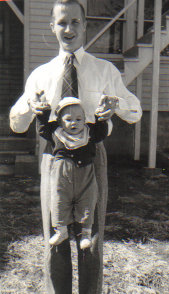
My Dad 1961

I was recently telling someone about an incident I had with my father when I was 9 or 10. After school, I would often ride my bicycle to the Boys Club. I loved the sloping descent on one street, because the increased speed fed my daredevil instincts and darting around other kids walking home on the sidewalk satisfied my impetus to show off.

On this particular day, I miscalculated my approach to a very busy street. When I realized I was too close for the brakes to stop me safely, I jumped off my bike and ran along beside to stop it, yelling at a group of kids at the corner, “Look out!” Even this technique did not correct my mistake and I ended up running out into the street, causing some cars to stop suddenly.

By the grace of God I had avoided a tragic accident. I was walking my bike back to the corner when I noticed a Ford station wagon pulling over. Getting out of the driver’s side was my dad. The look on his face said he was not coming to congratulate me on my bicycle skills. He did not hug me in joyful relief that I had not been injured. He told me to get into the car, then picked up my bike and threw it into the back of the station wagon.

Family's 1958 Ford Country Sedan station wagon

Wherever he was going, he took a detour to our house first. He didn’t say anything nor did I have to explain what had happened. As one of the drivers who had to slam on his brakes, he had a ringside view of my foolishness. I knew this was not going to end well for me.

When we arrived home, he turned off the car – bad sign. This meant he was coming in with me. He sent me to the bathroom. In my house, the bathroom did not merely offer privacy for various water functions. It was also the location for administering judicial penalties. Justice came swiftly that day – and painfully. In addition to the corrective spanking, my bike was impounded for several weeks.

This was one of my many trips to the bathroom for reverberating retribution. My dad was usually angry with me when he applied discipline to my backside, but he never crossed the line into uncontrolled beatings. He believed spankings would effectively drive the folly from my heart (Proverbs 22:15). In many ways it did, although it would take many other forms of discipline to persuade me that the paths of sin are not as rewarding as they appear.

I could have spun that story in many different ways. I could have resented my dad for embarrassing me in front of the kids who stood at the corner and observed my humiliation. I could have criticized my dad for his angry reaction rather than a compassionate response to my childish misjudgment. I could have overlooked my own arrogance and impudence. I could have easily forgotten what I did wrong and judged my dad for his faults.

Every adult makes these kinds of choices in evaluating their parents. None of us would have difficulty identifying dozens, scores, even hundreds of flaws in our parents and the mistreatment those flaws produced in our lives as children.

We can easily condemn the father who works all the time, neglecting family life, missing our ball games and musical performances, depriving us of fatherly compassion and wisdom. In our limited, and usually biased perspective, we can easily omit the context for our fathers’ behavior. The long hours of stressful and sometimes mind-numbing work may have been his expression of love in the way he could do it best. His own detached father may have handicapped him emotionally and parentally. He struggled to relate to his children, but he knew how to work hard and he was determined that his children would have everything he could not have as a child.

Hanging on to Dad

It’s our choice. We often act as prosecuting attorney, judge and jury, but seldom as the defense attorney. Our dads frequently receive a trial that omits so much evidence. We are content to condemn them and blame them for what is wrong with us. Sometimes we are not as much interested in truth as we are in justification.

My dad was seriously flawed, but so were my friends’ dads. There has never been nor will there ever be a perfect dad. We can choose to focus on the flaws or the merits of our fathers. I am not advocating a skewed perspective that ignores bad behavior. This distortion will often reproduce itself in evaluating our own lives. Seek an honest, just and prudent perspective. Give praise for his worthy traits. Give grace to his faults. You will be a better person for it.

Posted in Fathers, Perspective | Tagged , , , , , , , , | 2 Comments

TEACHERS WITHOUT UNDERSTANDING

If you are reading this, you must have missed the predicted departure. Harold Camping ventured into the treacherous waters of Bible prophecy to forecast a date when God would “catch up” the Church into heaven and launch a judgment on the remainder of the world. The day, May 21, came and went without any unusual phenomena.

Camping does not, nor has he ever served on a pastoral staff of a church. An engineer by training, he partnered with several people in 1958 to purchase an FM radio station to broadcast Christian programming. He ascended in influence on the Family Radio to become president and one of the leading teachers. Without formal theological training, Camping has evolved into a spiritual leader for many of his listeners.

Following the more recent brand of interpretations of Bible prophecy, Camping believes that Jesus will rapture the Church from the earth prior to a 7-year period of judgment called the Tribulation. At the conclusion of the Tribulation, Jesus will return to establish his kingdom on earth for a thousand years (Millennial Kingdom). The rapture sets the entire scheme in motion.

Camping has been fascinated with biblical history, establishing a date for the creation of the world of 11,031 BC. Using many biblical passages, Camping then turned to the rapture to try to determine its occurrence. He published the date of September 6 in his book, 1994, although he admitted, “the possibility does exist that I might be wrong.” When he was wrong, he corrected his calculations to September 29, then October 4, then March 31 – then he retreated.

It was somewhat surprising for Camping to attempt another date for the rapture. The day after May 21, Camping said he was “very disappointed,” but quickly set about reexamining the passages and revised his prediction. May 21 was only the beginning of God’s judgment in a spiritual sense, which will culminate in a final judgment October 21 of this year.

People dedicated themselves to spreading Camping's prediction

This may seem like harmless prattle, and it would be if nobody took him seriously. Abby Carson quit her nursing job two years ago and she and her husband devoted themselves to publicizing Camping’s prediction. They invested their own resources for their activities, as did Joel and Adrienne Martinez. After quitting their jobs, they sold their home and budgeted to live on their savings while they passed out tracts right up to May 21.

Many of his listeners have donated money so that he could spread the word to the world. In 2009 he received $18 million in donations. He contends that he does not need to return the money because he has not completed his task.

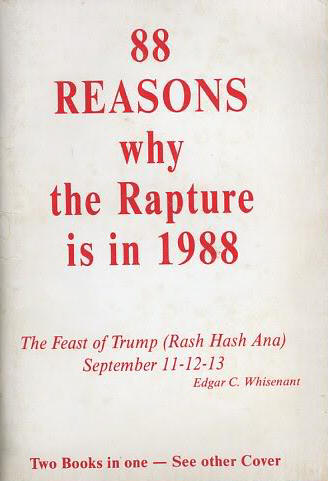
Many other people have unsuccessfully predicted the rapture or the end of the world, including Edgar Whisenant. The former NASA engineer immersed himself in a study of eschatology and published a small book 88 Reasons Why the Rapture Is in 1988. He was so certain of the date between September 11 and 13 that he said, “Only if the Bible is in error am I wrong … I would stake my life on Rosh Hashana 88.”

Whisenant decided that he had missed the date by a year. When that day passed, he corrected it to October 3. He followed that with a publication, The Final Shout – Rapture Report 1990. He altered his prediction by one year for the next 7 years, until finally he abandoned the project.

Many would categorize Camping and Whsenant as false prophets. They did make predictions that did not occur and according to Deuteronomy 18:20-22, if a prophet claims to speak for the Lord and his prophecy is not fulfilled, then he could be put to death.

I would place these man and many like them in the category of false teachers. They are not prophets in the true sense of the word because they do not claim that God has given them new revelation directly. Instead, these men contend that their predictions result from a diligent and scholarly study of the Scriptures. Although they may be diligent students of the Bible, many would contest that they are anything but scholarly.

In one sense these men do not differ from the preachers who stand in the pulpit week to week who intend to declare a message that conforms to Scriptural truth, or the teachers in seminary and on the radio who exegete the Bible for those who are less trained in this field, or the authors who offer biblical insights into life. All these people claim to impart God’s Word through careful study and interpretation. We are preachers and teachers of the Scriptures.

We should not be overly harsh on these men for their failed predictions. But we should impose a stern rebuke of them for their willingness to repeatedly mislead people into extremist behavior and misuse the financial resources entrusted to them. They should give an account for their careless teaching and irresponsible leadership. We should correct them for their lack of humility and failure to admit their presumption and foolishness.

Most of these men do not answer to any human authority. They minister independent of any denominational oversight. They often do not even submit to a local church’s authority. They answer only to themselves and are adept at dodging criticism and avoiding admission of wrong.

Paul says this about them, “Certain persons, by swerving from [a pure heart and a good conscience and a sincere faith], have wandered away into vain discussion, desiring to be teachers of the law, without understanding either what they are saying or the things about which they make confident assertions.” (1 Timothy 1:6-7)

The best thing to do is to turn them off when they come on the radio, don’t buy their books and stop listening to them.

Posted in Bible Teaching, Prophecy | Tagged , , , , , , , , , , , , , | Leave a comment