REORIENTING THE CHURCH

The Willow Creek Association’s Global Leadership Summit was less than one week away when Howard Schultz, CEO of Starbucks, called to say that he had decided not to speak at the Summit. Gay Rights activists threatened to boycott Starbucks if Schultz spoke at the event.

Political consultant Asher Huey posted a petition on Change.org calling for the boycott. “Schultz is speaking at a conference hosted at and sponsored by an anti-gay church. This is unacceptable,” the petition said. “The church has long practiced dangerous conversion therapy to ‘cure’ people of their sexual orientation. … Not denouncing these practices is tacit approval.”

Starbucks CEO Howard Schultz

Willow Creek supported Exodus International for many years. This ministry’s vision statement reads, “Mobilizing the body of Christ to minister grace and truth to a world impacted by homosexuality.” Exodus believes reorientation from same-sex attraction can occur, and has served tens of thousands of homosexuals since it began in 1976.

The petition had garnered over 700 signatures when Schultz requested to be removed from the speakers’ list. He did not want another PR black eye. Pastor Bill Hybels and WCA president Jim Mellado talked with Shultz for nearly an hour and agreed to release him from his contract without penalty.

In 2009, Willow Creek decided to discontinue its long-standing affiliation with Exodus. Assessing its recovery ministires, Willow’s leadership determined that many homosexuals did not experience the promised reorientation. In these cases, instead of therapy, Willow offers acceptance with a call to abstinence.

Willow Creek Pastor Bill Hybels

Hybels challenged the petition’s accusations in a public statement at the Summit. Clearly grieved by the charges, Hybels said, “… not only is Willow not anti-gay, Willow is not anti-anybody.”

Hybels continued, “Our church was founded on the idea that people matter to God. All people. All people of all backgrounds, all colors, ethnicities, and sexual orientation. The mat at every door on this campus has always read “Welcome.” And for over 35 years we have flung the doors of this campus open to the widest array of humanity I have ever witnessed in the global church. And thousands–tens of thousands–have come to learn the teachings of Jesus. So to suggest that we check sexual orientation or any other kind of issue at our doors is simply not true. Just ask the hundreds of people with same-sex attraction who attend our church every week.”

Willow Creek Community Church in South Barrington, IL

Don’t rush to judgment just yet, because Willow has not compromised the biblical standard on sexuality. Hybels stated, “Now what is true is that we challenge homosexuals and heterosexuals to live out the sexual ethics taught in the Scriptures–which encourages full sexual expression between a man and a woman in the context of marriage and prescribes sexual abstinence and purity for everybody else.”

Willow Creek has always positioned itself as a church who truly loves people – all people. It has struggled to extend that love in a godless culture without diluting or deserting biblical truth in the process. Willow has changed, adjusted and modified to attract every person who is willing to listen to the message of the healing and forgiveness of God through Jesus, and they have striven to do it with integrity.

Bill Hybels addressing the Leadership Summit

Hybels lamented, “But even as we challenge all of our people to these biblical standards, we do so with grace-filled spirits, knowing the confusion and brokenness that is rampant in our fallen world. And at Willow we honor the journey of everyone who is sincerely attempting to follow Christ. So it’s unfortunate that we could not have explained this to those called us anti-gay and started this petition.”

A close look at the life of Jesus reveals a startling contrast to popular Christianity.  He was criticized by the respected religious leaders for eating with tax collectors and sinners. Society’s outcasts felt comfortable in his presence. Prostitutes worshiped him. The sick, broken, unsavory and rejected flocked to him like ants to a picnic. They sensed that he was safe, that he would not condemn them for their bad choices and failures, and that he could provide healing. He gave them hope. He gave them love.

Christ followers incarnate Jesus in and to the world, but respectability has defaced our image. The tax collectors and sinners would rather starve than sit down for a meal in a church. Instead of love, they expect judgment. Instead of acceptance, they expect scolding. Instead of hope, they fear walking away with more guilt.

But wait. Wasn’t Willow misjudged and condemned? Yes it was. But instead of striking back, it opened its arms wider, inviting the very people who denounced it to come and eat at the table of Jesus, where no one is denied for any reason.

Current criticism of Christians, deserved or unfair, requires the followers of Jesus to make extraordinary efforts to reach out in love to the tax collectors and sinners – that is, if we are ready to be criticized by the other side of society like Jesus was. Perhaps the Church needs its own reorientation.
Posted in Homosexuality, The Church - the Body of Christ | Tagged , , , , , , , | Leave a comment

ONE SMALL CHOICE, ONE GIANT EFFECT

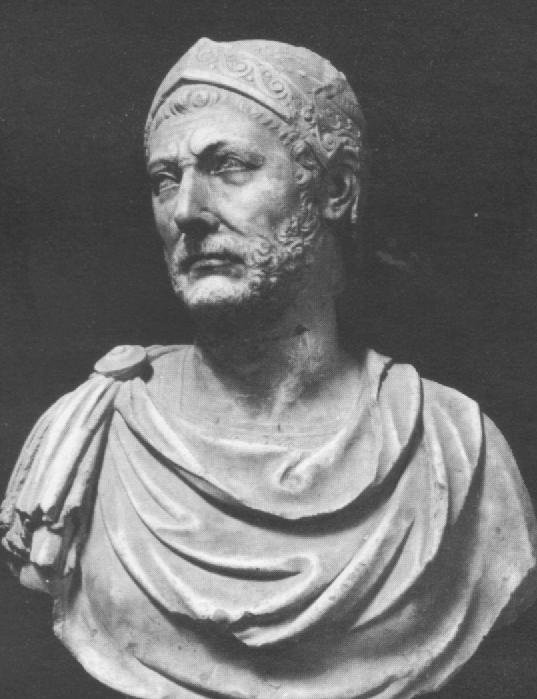
Hannibal (247 BC - 183/182 BC), son of Hamilcar Barca

Most decisions make small ripples in our ponds of life, but occasionally one decision can have a tsunami-like impact. Hannibal the Great made one such decision in 218 BC, which probably altered the face of Western civilization.

Hannibal’s father, Hamilcar Barca, rose in power to become the commander of the Carthaginian army in the third century BC. The Carthage empire extended along the coast of North Africa and under Hamilcar, it acquired a large territory in the Iberian peninsula (Spain). When Hamilcar drowned in battle, his son-in-law, Hasdrubal the Fair, succeeded him. Hasdrubal was assassinated in 221 BC and the army pledged its allegiance to Hannibal, confirmed by the governing powers.

Hannibal, a tactical genius, incited Rome to declare war against Carthage for a second time (the Second Punic War). In 218 BC, Hannibal set out from Cartagena in Spain to take the war to Rome. Three routes were available. He could cross the Mediterranean, but Rome controlled the sea. He could take the long land route, but this would diminish his element of surprise. The third and shorter route required crossing the Alps, a nearly impossible feat.

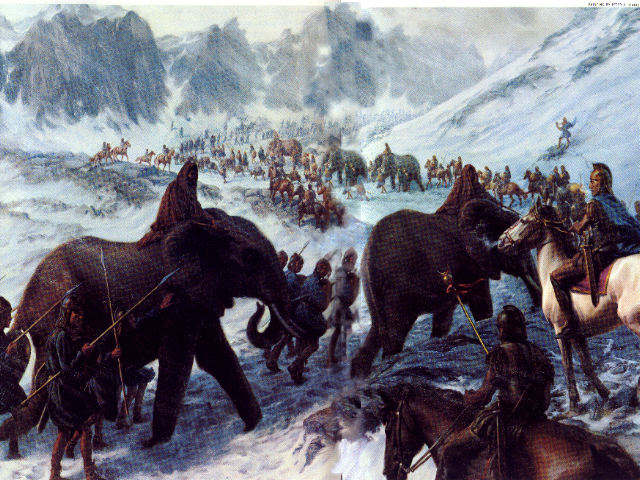
A brilliant tactician, Hannibal chose the impossible, setting out with 50,000 troops, 9,000 horses and pack animals and 37 elephants, He won several battles along the way and devised ingenious schemes to cross the Rhone River before reaching the Alps. The ascent proved treacherous, but the descent was worse.

Basing his report on Polybius and Livy, Stephen Weir (History’s Worst Decisions) records Hannibal’s march. With no real knowledge of the Alps, Hannibal discovered a hazardous terrain of an ice substratum hidden by mud. Men and animals could hardly remain on their feet. A snow storm compounded their journey’s nightmare. But another unsuspected calamity was coiled to strike.

Hannibal's army traversing the Alps

Trudging through the snow, mud and ice, the army suddenly stopped. Hannibal, marching at the rear, came tromping to the front, furious by the increasing delay. A large snow drift blocked their progress. Angered by the indecisiveness and determined to demonstrate that an ice base lay beneath the snow, he slammed his walking cane into the drift onto the ice.

Of the one million avalanches annually, over half of them occur in this small region. In some locations, the slightest disturbance can trigger a snowslide. Hannibal’s rash action brought the mountain side down on his army. After digging out for four days, they determined that less than half of his army and even fewer animals had survived.

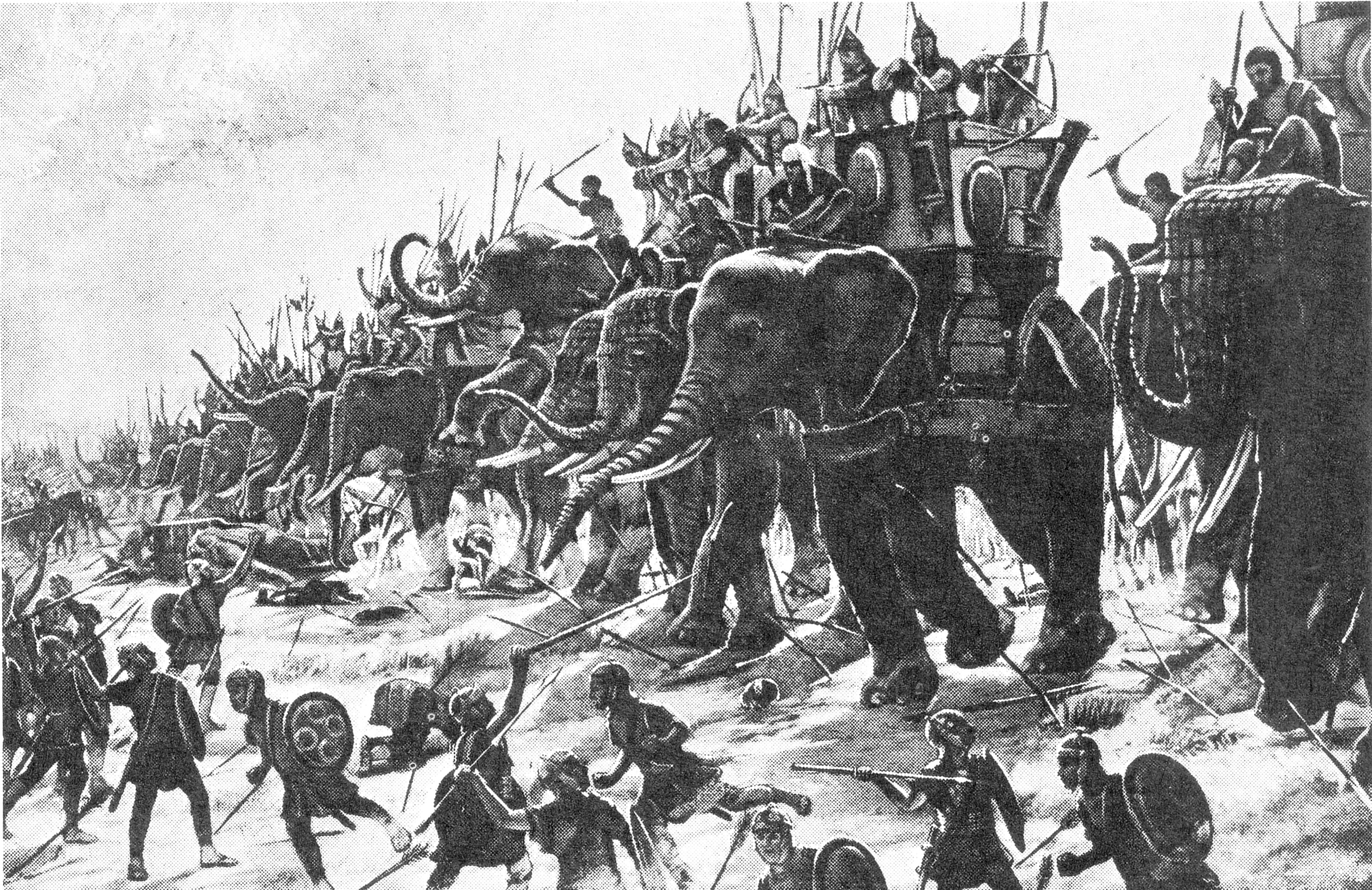
With a will colder than the Alpine ice, Hannibal led his depleted army out of the Alps, picking up additional troops from a Gallic tribe in the region. He won two swift battles, catching the Romans completely off-guard. Rome sent a large force to engage him in Cannae, which Hannibal routed with remarkable military genius.

Knowing that he did not have the numbers to attack Rome, Hannibal sent for reinforcements. A sizeable army, led by his brother, entered Italy, but was immediately intercepted and destroyed by the waiting Romans.

Hannibal engages Scipio at Zama

Rome recognized Hannibal’s superior skill in open combat and decided to allow Hannibal to wander around southern Italy without engaging him head on. Hannibal could not muster enough troops for an invasion of Rome. After ten years, the Roman general, Scipio Africanus, led an assault on Spanish territories and maneuvered his forces through North Africa, targeting Carthage. Hannibal returned to defend Carthage and Scipio defeated him at Zama in 202 BC.

Hannibal posed the most serious threat to Rome’s world dominance. His brilliance promised to dethrone the Roman Republic before Augustus ever established the Empire 200 years later. But his impulsive temper derailed his campaign before it was out of the Alps, sending shock waves through the Alpine canyons into future generations. The Roman Empire has left the largest footprint on Western civilization. What if the Carthaginian general had severed the foot before it ever stepped into Western history? One can only imagine?

Another great leader had to learn that a power exists that transcends the genius and skills of even the greatest human leaders. Nebuchadnezzar extended Babylonian authority throughout the Middle East. He had a very disturbing dream and called for his advisers to interpret it for him. God sent his prophet, Daniel, to explain the meaning of the dream. In essence, the dream illustrated that God, “changes times and seasons; he removes kings and sets up kings.” (Daniel 2:21)

“… the Most High rules the kingdom of men and gives it to whom he will and sets over it the lowliest of men.” (Dan. 4:17) This King of kings infuses his absolute power into the decisions and actions of his human creatures, ensuring that the course of history will follow his determined path. Men still defy his will and resist his authority, but he persistently prevails.

One rash act may have changed the face of history. How many times has this repeated itself? How often has the Ruler of heaven and earth used or directed these events for a greater purpose?

Chaos continues its encroachment on world affairs. Humans are losing confidence in themselves to solve the problems they invent for themselves new every day. Peace comes only if there is a good and just and merciful God in control. The Scriptures reveal just such a God. “I know, O Lord, that the way of man is not in himself, that it is not in man who walks to direct his steps.” (Jeremiah 10:23) So who oversees his steps? “The heart of man plans his steps, but the Lord establishes his steps.” (Proverbs 16:9)

God will use even the small choices of great leaders to accomplish great effects for his plan.

Posted in God and History, Sovereignty of God | Tagged , , , , | Leave a comment

WINSOME PERSUASION

Syracuse University flag

Rosaria Champagne was an associate professor of English at SyracuseUniversity.  She also served in the Center for Women’s Studies at her university as a specialist in queer theory, a postmodern form of gay and lesbian studies, living in a lesbian partnership of several years with a female psychology professor.  As a convinced postmodernist, she believed there is no truth, only truth claims.

Rosaria explains that the only exposure she had with Christians were from “students who refused to read papers on the grounds that knowing Jesus meant never needing to know anything else, people who sent her hate mail, or people who carried signs at Gay Pride marches, which read, ‘God hates fags.’”  She had formulated the opinion that “Christians always seemed like bad thinkers” as well as “bad readers.”  She concluded that Christians maintain their worldview only because they are unwilling to engage the complex problems of the world like poverty and violence.  When Christians became uncomfortable in discourse it seemed to her that they resorted to their mantra, “the Bible says,” not to deepen the conversation, but in the hope of ending it.

In 1997 she wrote a critique of Promise Keepers for the local newspaper and received the usual hate mail from Christians – with one exception.  Pastor Ken Smith graciously responded with questions rather than dogmatic judgment.  He asked her how she had arrived at her interpretation, and how she knew that this interpretation was right.  He was asking her to examine her presuppositions, something no one had done before, and he did it with kindness.

She kept his letter on her desk for a week, not knowing what to do with it.  Then she decided to call him.  She was involved in research for a book on the rise of the Religious Right in America and its tactic of using hate against homosexuals.  Talking with Ken would provide additional material for her book.  He invited her to dinner at his home with his wife, Floy, and she accepted.

A number of things created a safe environment for Rosaria as she entered Ken and Floy’s home.  When Ken prayed for their meal and evening, she was not prepared for the genuineness of his prayer.  She was used to the pretentious prayers of Christians at Gay Pride protests.  She comments,

“I had never heard anyone pray to God as if God cared, as if God listened, as if God answered.  It was not a pretentious prayer uttered for the heathen at the table to overhear.”

Their conversation that evening was engaging, but not disagreeable.  She left Ken and Floy’s home with a genuine desire to know if God existed, wondering if she even had the courage to face what she might discover in this quest.

This encounter led to more evenings together, and even a friendship with these non-stereotypical Christians.  On one occasion Ken offered to do a lecture on the literary value of the Bible to English studies for her English students.  She was not ready to unloose an evangelical in her classroom yet, but she did ask him to do the lecture for her.  In it he gave an overview of the sixty-six books of the Bible and how they contributed to the central message of redemption and forgiveness that unified all the books.  When he was finished she was infuriated, primarily because her worldview was placed in jeopardy.  If Ken was right, her beliefs were very wrong.  There was no postmodern middle ground.  So she asked him how he knew his Bible was true.  He was delighted to meet with her again to address that question.

For the first time Rosaria was confronted with the price that sin demanded, requiring the Son of God to come to earth in order to suffer the wrath of His Father for the sins of His creatures.  She imagined how secure her world might be if this message were true, if there really was an unchangeable truth, if there really was a man-God who was willing to deal with the sin problem personally.  But, she determined, God had made her a lesbian and not a Christian.

Her book research required her to read the primary source for Christianity – the Bible.  She read it and reread it.  In it she was discovering a consistent worldview that differed dramatically from her Marxist, postmodern worldview.

The message of this book was compelling, and was steadily eroding her presuppositions about Christianity.  With the precision of a surgeon’s scalpel the Bible was dividing the thoughts and intents of her heart, and slowly unraveling her belief system.

It was two years before she had the courage to enter Ken’s church, with her butch haircut and her truck bearing the bumper stickers advocating gay pride and pro-choice.  She was surprised to find a community as warm as its pastor and his wife.  Finally, she came to the  place where she realized that she had to make a choice.  God was calling her to repent of her sin, not wait for healing from a disease.  The continuing transformation has not been easy for her, but Rosaria is now married to a pastor and using her gifts to serve the Church.

Here was an intelligent, articulate successful young woman who had some deeply ingrained beliefs that needed to be changed.  The hate tactic was not working.  Denouncing homosexuals publicly was not working.  She needed someone who was willing to take a risk and reach out to her with the love of Jesus.  She needed to be exposed to truth in an environment free from self-righteous condemnation.  It was through this tactic that God drew Rosaria to himself, through the humble, patient love of one of God’s messengers.

Posted in Christians Engaging Culture, Homosexuality, Transformed Lives | Tagged , , , , , , , , , , , | 3 Comments

A REALLY HAPPY LIFE

Dalai Lama speaking at the UIC Pavilion July 17

“We all come from a mother’s womb … everyone wants (a) happy life … everyone has a right to further that desire.” The Dalai Lama spoke these words at the UIC Pavilion on Sunday. His address attracted over 8,000 people.

The Dalai Lama also stated, “The very purpose of different religions is to create inner peace, tolerance, forgiveness and patience.” At one time he believed that his Buddhist religion was superior to other religions, which were “so-so.” Meeting other spiritual leaders like Thomas Merton and Mother Theresa changed that. Now he sees “the bridge between religions.”

The increase in religious violence clashes with the Buddhist monk’s message of non-violence. “Conflict in the name of religion is difficult to understand.” Violence contradicts any religion that has as its goal tolerance and forgiveness, and impedes any effort to achieve world peace.

Dalai Lama at UIC Pavilion July 17

The audience sat spellbound during the Dalai Lama’s two-hour speech. Samantha Castello summed up her experience, “Learning more about him has led me to a more spiritual path of enlightenment, peacefulness, happiness.”

Many people interpret the Dalai Lama’s message as harmonious with Jesus’ teaching. Both leaders advocate love and compassion as a way of life. Jesus surpassed every standard of love in his day when he said, “You have heard that it was said, ‘You shall love your neighbor and hate your enemy.’ But I say to you, Love your enemies and pray for those who persecute you so that you may be sons of your Father who is in heaven.” (Matthew 5:43-44)

Although Jesus and the Dalai Lama call for the same behavior and agree on the virtues that constitute the good life, the similarities end there.

The sources of these virtues differ in the two religious systems. Christian ethics grounds itself in the character of the personal and moral God. As personal creatures, we have the moral responsibility to act in compliance with God’s standard of goodness, which comes from his own nature.

Dalai Lama on stage at UIC Pavilion July 17

Buddhism knows no such God. Karma compels moral behavior for Buddhists. Karma is a universal law of existence. Violating karma results in consequences, like throwing a ball into the air will always result in it falling back towards the earth. Because it is impersonal and amoral, breaking the rule of karma does not result in sin or the threat of judgment, only a negative and unwanted result.

Why does this matter? Don’t both religions produce the same desirable outcome? Only superficially. If sin has infected every aspect of human nature, then virtuous behavior requires the control of that sinful impulse. Rewards and punishment, the essence of karma, can train some people to adopt some virtues to a certain level.

But many people refuse to conform to the standards, regardless of the consequences. They believe that the benefits of bad behavior outweigh any risk of negative effects. They are pursuing a “happy life” as they desire it.

Buddhism cannot adequately explain the failure of karma to motivate every person towards virtue. Nor does it provide a comprehensive explanation of evil.

Sin exists on a limited scale in Buddhism, referring to deliberate acts of evil or to any evil desire. The system does not require any judgment for sin, but only a movement away from it and toward virtue through enlightened practices.

A habit of enlightened practices grows out of the abandonment of evil desires. In fact, Buddhism teaches that enlightenment occurs in the absence of all earthly desires. On this level, it makes no distinction between good and evil desires, but all human desire interferes with ultimate spiritual reality. Buddhism denies reality to achieve ultimate reality.

Christian distinctions of good and evil are derived from the nature of God. Although evil cannot be explained exhaustively in Christian theology, its teaching is much more comprehensive and friendlier to experience.

Ani Choying concludes Dalai Lama's message singing "Amazing Grace"

It seems ironic that the UIC program concluded with a Buddhist performer singing “Amazing Grace.” The song rejoices in a salvation from sin through the grace of a personal and just God, not a personal enlightenment through the denial of desires.

We live in a moral universe where moral creatures make moral choices every day. The effects of those moral choices exist because a moral God has established the moral rules for his creatures. These effects are both physical and spiritual in nature and they all point to the ultimate reality of a personal God.

We can all applaud the Dalia Lama’s appeal to love and peace, but those words should not confuse us about reality. What Jesus taught for experiencing and achieving those virtues differs significantly from what the Dalai Lama teaches. Jesus appealed to a personal God, who does not even exist in Buddhism.

Your happiness depends upon which system you choose for pursuing it. “How beautiful upon the mountains are the feet of him who brings good news, who publishes peace, who brings good news of happiness, who publishes salvation, who says to Zion, ‘Your God reigns.’” Isaiah 52:7

Posted in Christianity and Buddhism, Morality, Virtue | Tagged , , , , , , , , , , , , , , , | Leave a comment

UNCOMMON GENEROSITY

Court Crandall had watched his son, Chase, play basketball on club teams for several years with students from nearby Compton High School of Los Angeles, whose 2530 students divides into 74 percent Hispanic and 25 percent African American. Father and son discussed the divide between the opportunities that students from his own school in Manhattan Beach enjoyed in contrast to those of students at Compton.

The dropout rate in 2009-2010 at Compton reached 27 percent. Of the 317 graduates in 2010, only two had completed course work required for entrance into the University of California or California State.

Crandall, an advertising executive, created a competition for Compton graduating seniors. Applicants had to have at least a 3.0 GPA, which narrowed the field from 500 to 80 students. Eight were chosen at random to participate in a free throw contest. The winner would receive $40,000 in scholarship money to the school of his or her choice. All other contestants would receive a $1,000 scholarship.

Six of the participants in the Free Throw competition

Participants included Victory Holley, a band majorette and one of twelve children being raised by their single mother. Omar Guzman would be the first high school graduate in his family. Efren Arellano’s parents are immigrants, working in factories to give their children some hope for a future. Allan Guei, son of Ivory Coast immigrants, was the captain of the basketball team, but he still qualified academically. All eight had been accepted into colleges, but had no idea how they would afford them.

Crandall “thought the free throw is a good metaphor in a world where there’s a bunch of lines that are kind of dividing us. The focus became, how do we show the world another side of Compton, that’s more positive, beyond the stereotypical guns and crime stuff?” He filmed the project as a documentary, “Free Throw,” which he will submit to the Sundance Film Festival in September.

Allan Guei and Free Throw participants

The contest took place in March in Compton’s packed field house. Guei won the $40,000 prize. Crandall shocked the other seven students by announcing that his company had raised enough money to provide scholarships for one year of tuition for all seven.

In June, “Free Throw” had a major unscripted plot twist. Guei returned the $40,000 to Crandall with instructions to divide it between the other seven participants. Guei had received a full scholarship from Cal State Northridge. He said, “I’ve already been blessed so much and I know we’re living with a bad economy, so I know this money can really help my classmates. It was the right decision.”

Guei signs with Cal State Northridge

Perhaps Guei has insulated himself from marketing propaganda to nurture the virtue of contentment, a satisfaction with one’s status and condition in life. Guei’s vision has not become near-sighted from the perpetual exposure to the blinding glitter of an affluent America. He has not developed cravings that make him a selfish opportunist.

This high school graduate still sees others around him with their needs. He has kindled compassion and generosity rather than indifference and greed. His decision to distribute the money to his classmates would stun most Americans.

Here is humanity at its best. This benevolence should inspire all of us to examine our own habits. Most of us enjoy an abundance far beyond what we truly need to be content. One has to wonder why.

We enter the world without anything and we exit the world without anything. That should give us a clue about the nature of possessions. Jesus told his disciples that we are merely stewards of God’s household (Luke 12:42). That means that nothing we possess really belongs to us, but we are only managing it for someone else.

A manager wants to maximize the productivity of his personnel and resources in a way that benefits the company (or in this case, the household). If he manages those resources to benefit himself only, he will not be working for that company very long.

Jesus said, “Everyone to whom much was given, of him much will be required and to whom they entrusted much, they will demand the more.” (Luke 12:48) Allan Guei has demonstrated marvelous managerial skills. How much more should those of us who know the Master of the household give generously to the needs that exceed ours?

Posted in Contentment, Generosity, Stweardship | Tagged , , , , , , , , , , , , , | Leave a comment