REALISTIC HOPE

hope 1Recently my niece was interviewed for a job. The interviewer asked her, “If you could have any three things you wanted, what would they be.” My niece thought for a moment and then answered, “I would want to eliminate world hunger. I would want to eliminate world poverty. And I would want to evangelize the entire world.”

Before you chuckle about her noble idealism, take a more careful look at what members of the Millennial generation (aka Generation Y) are doing. Different writers use different terminals to identify this generation, but Thom and Jess Rainer have determined to study those people born between 1980 and 2000 (inclusively).

In The Millennials: Connecting to America’s Largest Generation, they reveal some surprising discoveries. Participants in the study were asked to respond to a series of statements. To the statement, “I believe I can do something great,” 60% strongly agreed and 36% agreed somewhat. That response is staggering.

hope 2

Seniors at Clemson University (Photo credit: Trayson Llano)

Of course, this is the generation raised by the Baby Boomers, who decided that human self-esteem is too fragile to endure criticism. They praised their children and their students for the smallest steps of progress and sought to insulate their children’s egos from any form of negativity. Some people have called the Millennials the Coddled Generation.

Follow-up interviews with participants unearthed an important truth. These young people do not define greatness in personal achievements like fortune or fame, but in making a difference in the world. For example, Emily said, “I really plan to make some contribution to this world in my lifetime. I don’t care if I rise to the top of an organization or become a political power broker. I just want to make a contribution.”

hope 3Sharon reflected this sentiment, too. Born in 1984, she is a practicing registered nurse while she works on her doctorate in nursing. When the earthquake crumbled Haiti in 2010, Sharon took two weeks of vacation so she could go to Haiti and serve. Her employer tacked on an additional week of paid leave. She reported, “Those three weeks in Haiti were life changing for me. That’s what I mean when I say I want to be great. I want to do something that makes a difference. I am doing something that makes a difference.”

Rainer writes, “Thus we have a generation of optimists unlike the Gen X members before them. …They know that not all is well with the world. The Boomer Generation knew that and protested it. The Gen X Generation knew that and was depressed about it. And the Millennials know that, but they believe they can have a role in changing it.”

Millennials largely filled the ranks of the recent protest movement, Occupy Wall Street. The occupation protest began September 17 last year and continues nearly sex months later. On October 5, over 15,000 protestors collected for a solidarity march in lower Manhattan. Occupy has spawned peaceful protests in 951 cities in 82 countries.

hope 4Some have criticized Occupy for its vague agenda, but the web site, occupywallst.org, sums up its grievance. “Our nation, our species and our world are in crisis. The U.S. has an important role to play in the solution, but we can no longer afford to let corporate greed and corrupt politics set the policies of the nation.” Wanting to correct the social and financial inequalities in our country, Millennials are attempting to influence what Edward Murray calls “the biggest, most ambitious, social reform of any financial system in our nation’s history.”

Occupy may succeed. It may not. Regardless, I suspect that Millennials will continue to find ways to make a difference in the world, both small and large differences. They are doing what followers of Jesus Christ have been called to do. Jesus instructed his disciples, “Go into all the world and proclaim the gospel to the whole creation.” (Mark 16:15)

This gospel brings radical transformation to those who trust in it, “And we all, with unveiled face, beholding the glory of the Lord, are being transformed into the same image, from one degree of glory to another.” (2 Cor 3:18) As people are transformed, CEO’s are transformed, politicians are transformed, government leaders are transformed. As people are transformed, institutions are transformed, power structures are transformed, financial systems are transformed.

Shouldn’t Jesus’ followers display the same passion and optimism of the Millennials? Jesus called us to proclaim the gospel of his kingdom. Where the gospel implants itself, people’s lives are changed and the kingdom of God surfaces. Jesus said the gates of hell cannot successfully stand against that kingdom (Mt 16:18).

Millennials often populate building crews of Sold Rock Carpenters when they travel to Louisiana to build houses for the poor.

Millennials often populate building crews of Sold Rock Carpenters when they travel to Louisiana to build houses for the poor.

For example, Scott, Jeff and Mark Engle were moved with compassion when they saw the devastation of Hurricane Katrina in 2005. These Christian brothers began Solid Rock Carpenters to organize teams of volunteers from Chicago to travel to the south two or three times a year and partner with Habitat for Humanity in making a difference. They have led thousands of volunteers on more than 30 trips and built 23 houses in the Delta and more than a dozen in Mexico. They are bringing the kingdom of God to a place where they find brokenness and replacing despair with hope.

That kingdom does not mean mere paradigm shifts of belief, but dramatic life changes. And those life changes mean systemic reformation. Jesus inaugurated his ministry in a Nazareth synagogue with a quote from Isaiah. “The Spirit of the Lord is upon me, because he has anointed me to proclaim good news to the poor. He has sent me to proclaim liberty to the captives, and recovering of sight to the blind, to set at liberty those who are oppressed, to proclaim the year of the Lord’s favor.” Jesus put away the Old Testament scroll, looked at his hearers and said, “Today this Scripture has been fulfilled in your hearing.”

Jesus then set about traveling throughout the region preaching the good news of the kingdom of God that was now present. He healed the sick, set people free from demonic oppression, brought forgiveness to those suffering from guilt, and removed the spiritual and social bonds that imprisoned people. When he left earth, he transferred this same ministry to his followers.

In obedience to Jesus and in the power of his Spirit, we have a realistic hope of seeing genuine transformation of the world around us. We can and should make a difference. Thanks to the Millennials who are reminding us of our calling.


Posted in Kingdom of God, Millennials, The Gospel, Transformed Lives, Uncategorized | Tagged , , , | Leave a comment

MODELING HONOR

Kylie Bisutti

Kylie Bisutti (Photo Credit: CBS Television)

Shock waves rumbled throughout the modeling world in December when a Victoria’s Secret model walked off the runway. Kylie Bisuttii achieved national recognition in 2009 when she won the nationally televised Victoria’s Secret Model Search over 10,000 contestants. She was 19.

Almost 2 years later, to the day, she did not appear in the televised Victoria’s Secret Fashion Show (Dec. 1). Wanting to explain her absence, Bisutti tweeted, “I have decided not to model lingerie because I personally feel that I am not honoring God or my husband by doing it.”

“My marriage is very important & with divorce rates rising I want to do everything I can to protect my marriage and be respectful to my husband,” she continued. “God graciously gave me this marriage and this life and my desire is to live a Godly faithful life, I don’t however judge others for what they do. Everyone is convicted on different levels.”

In an interview on “ABC Good Morning America,” Bisutti told George Stephanopoulos that she is a “strong believing Christian” and had been reading her Bible more lately. “I was growing in my relationship with the Lord and in my faith. I just became so convicted of wanting to honor my husband with my body and wanting to be a role model for other women out there who look up to me.”

Kylie and her husband Mike Bisutti (Photos by Starzlife)

Kylie and her husband Mike Bisutti (Photos by Starzlife)

A recent encounter with her eight-year-old cousin had stopped her in her tracks. Watching Bisutti put on her makeup, the little girl told her, “You know, I think I want to stop eating so that I can look like you.” Bisutti was forced to reexamine the message she was sending to her fans, especially the young ones. “It broke my heart because she looks up to me … Thousands of girls that think that being beautiful is an outer issue and really it’s a heart issue.”

Every celebrity bears the responsibility of a message. The media relentlessly scrutinizes the lives of celebrities, often exposing things most people manage to keep private. This scrutiny demands that celebrities live more circumspectly. The message of their lives carries significant clout with many impressionable fans.

For two years, Bisutti lived out a message about the female body and about female identity. She believed her message did not conflict with Christian values or God’s moral standards. The more she read the Bible, the more she questioned that belief. One day last fall, she embraced a new identity and adopted a new moral standard, compelling her to modify her career.

Kylie 3

(Twitter/@VSKylie)

She also learned that not everyone was correctly interpreting the message she hoped to send. She believes that the core of a woman’s beauty is internal, but little girls like her cousin saw only the external beauty. Wanting the kind of attention that this kind of beauty attracts, these young girls may make unwise and unhealthy choices to acquire it.

Although Bisutti has not made any judgmental comments about Victoria’s Secret or her modeling colleagues, her decision offers a corrective to the entire modeling industry. What messages does the company send on its runways and in its advertising? What moral standard allows a woman to reveal her mostly naked body to whomever wants to view it? What message does this practice broadcast about human nature? About women? About beauty? About modesty? About sexuality?

Bisutti’s choice cannot be relativized. Her new beliefs challenge the beliefs of others. Both sets of beliefs cannot be right. Does modeling lingerie honor God or not? Does the display of her body violate the sacred nature of her marriage or does it not? Or does marriage even have a sacred dimension that is affected by these kinds of choices?

Kylie being interviewed on ABC Good Morning America

Kylie being interviewed on ABC Good Morning America

If Bisutti’s beliefs are right, then contradictory beliefs are wrong. If Bisutti correctly interprets reality, then modeling that requires a woman to unveil most of her body devalues that woman’s self-esteem. It degrades female identity. It desecrates (“to divert from a sacred to a profane use or purpose”) the human body.

Not only has Bisutti declared a message about morality, but she has modeled exemplary courage and conviction. Wearing Victoria’s Secret wings brings prestige and wealth. She traded the admiration of millions for the praise of two, her husband and her God.

We can only hope that the millions are paying attention to this message. But even if they are not, Bisutti will live at peace with her conscience. She will enjoy the deep respect of a husband, who will find new ways to cherish his wife. And she will delight in an open and honest relationship with her God.

Posted in Beauty, Character, Sexuality, Women | Tagged , , , , | Leave a comment

DISCOVERING SPIRITUAL WIMPINESS

Kibera slum in Nairobi, Kenya

Kibera slum in Nairobi, Kenya

I think of myself as a fairly mature Christian. I have been following Jesus now for over thirty years. I entrusted my plans for my future with him when I decided to abandon a promising career in music and apply to seminary. I have traded the pursuit of wealth and career success for the path of service and sacrifice in ministry.

But as soon as my faith is tested, I prove to be a spiritual wimp. When the threat of loss stares me in the face, I scream like the kid whose parents told him they had eaten all of his Halloween candy (cf. YouTube). As soon as our great enemy starts whipping me around and pummeling me with his lies and adversity, I panic like a scared pup in a thunderstorm.

I have come to realize that the measure of maturity for Christians in the Western world must surely differ from the rest of the world. Brian Fikkert discovered his spiritual wimpiness when he traveled to Nairobi, Kenya. Fikkert teaches economics at Covenant College in Lookout Mountain, Georgia. He founded and directs the Chalmers Center for Economic Development.

Children rummage through garbage heaps between houses in Kibera

Children rummage through garbage heaps between houses in Kibera (Photo: myseveralworlds.com)

Although he had traveled to many poverty infested slums of the world, Fikkert thought that the Kibera slum of Nairobi may be the pit of hell. The second largest urban slum in Africa, third in the world, houses over 170,000 people in mostly cardboard huts. Children rummage through garbage heaps for scraps of food. Open ditches transport human sewage between shacks.

Walking around rubbish and trying not to slip on the wet brown substance that covered the ground, a cloud of despair settled on Fikkert as he observed this God-forsaken mass of humanity. Here was poverty on steroids.

Then he heard voices singing, singing a familiar hymn. Thinking some Western missionary must be conducting an open-air service, he was shocked to find a church of about thirty Kibera residents. Every Sunday they jammed themselves into a ten-by-twenty foot “sanctuary” of cardboard stapled to studs.

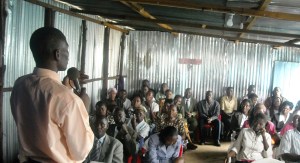
Pastor Emmanuel preaching at the Life in Christ Church in Kibera in 2009

Pastor Emmanuel preaching at the Life in Christ Church in Kibera in 2009 (Photo: http://www.freewebs.com/licomkenya/ministrynews.htm)

Someone immediately asked Fikkert to preach for them that Sunday morning. As a well-trained Presbyterian, he began jotting down notes for a message on the sovereignty of God. He thought this would be a choice opportunity to teach these poor people on one of the great doctrines of Scriptures. He soon discovered that this divine appointment was for his benefit, not theirs.

Before the sermon, the worshipers usually enjoyed a time of sharing and prayer. Fikkert heard the desperate pleas of these Christ-followers. “Jehovah Jireh, please heal my son, as he is going blind.” “Merciful Lord, please protect me when I go home today, for my husband always beats me.” “Sovereign King, please provide my children with enough food today, as they are hungry.”

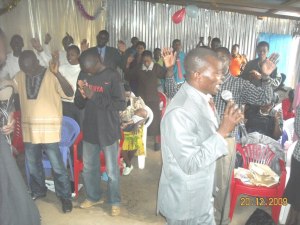
Members of the Life in Christ Church of Kibera praying

Members of the Life in Christ Church of Kibera praying (Photo: http://www.freewebs.com/licomkenya/ministrynews.htm)

Listening to these children of God cry out to their Father for the most basic needs of life, he reflected on his comfortable home, his two cars, a health insurance policy, life insurance policy, retirement fund, his substantial monthly salary and a long list of personal resources. Humbled by the contrast, his perspective experienced a major transformation.

“I realized that I do not really trust in God’s sovereignty on a daily basis, as I have sufficient buffers in place to shield me from most economic shocks. I realized that when these folks pray the fourth petition of the Lord’s prayer – Give us this day our daily bread – their minds do not wander as mine so often does. I realized that while I have sufficient education and training to deliver a sermon on God’s sovereignty with no forewarning, these slum dwellers were trusting in God’s sovereignty just to get them through the day. And I realized that these people had a far deeper intimacy with God than I probably will ever have in my entire life.”

This experience unraveled a basic belief that most Western Christians secretly, and probably unconsciously, embrace. Fikkert continues, “I was still amazed to see people in this Kenyan slum who were simultaneously so spiritually strong and so devastatingly poor. Right down there in the bowels of hell was this Kenyan church, filled with spiritual giants who were struggling just to eat every day. This shocked me. At some level I had implicitly assumed that my economic superiority goes hand in hand with my spiritual superiority. This is none other than the lie of the health and wealth gospel: spiritual maturity leads to financial prosperity.” (When Helping Hurts)

Church in Tula, Russia

Church in Tula, Russia

I was confronted with this same smug arrogance for the first time when I spent two weeks teaching pastors and local church leaders in Tula, Russia. These men and women were far from poor by most standards, but they lacked the kind of wealth and education that I bask in daily. They traveled long distances and stayed in hostels or church members’ homes so that they could improve themselves to better feed their congregations with the bread of heaven.

My delusional superiority was unmasked again when I helped with a dental mission trip to Haiti. Many of the people we treated were poor by any standard. Yet these people worshiped the God of creation with a joy and faith that shamed my shallow Christianity. They are forced to rely on God for the basic essentials of life, the things I never have to ask God for. Their joy reveals a depth of spiritual strength I rarely experience personally.

The Scriptures never condemn wealth, but always treat it as a blessing of God. Biblical authors do, however, repeatedly warn against the “deceitfulness of riches” (Mt 13:22), which will surely bring disappointment to those who trust in them (Prov 11:28). On the other hand, James points out, “… has not God chosen those who are poor in the world to be rich in faith and heirs of the kingdom” (2:5).

Most of us need to work tirelessly to uproot the pernicious superiority that stunts our spiritual growth. One way to do that is to find ways to serve the poor. They have much to teach us.

Posted in Faith, Poverty, Sovereignty of God, Spiritual Maturity | Leave a comment

THE CONFOUNDING CHURCH

Eighteen million views and counting. Jefferson Bethke posted his well-crafted four-minute video on YouTube January 10. “Viral” might be an understatement.

Bethke uses rapper-like poetry to communicate his message in “Why I Hate Religion, But Love Jesus.” He begins with the claim, “What if I told you that Jesus came to abolish religion?” He intends to challenge the hypocrisy that creeps into every organized religion, but his broad brush paints a confusing depiction of Jesus v Religion.

Behtke 1

Jefferson Bethke in his video

Bethke admits to playing this game, “acting like a church kid, while addicted to pornography.” He manufactured a “good” image, while hiding a corrupted life. This masquerade drives his critique of a “religious” church, where actors can fake piety by keeping the unwritten rules of the religious community. “See the problem with religion, is it never gets to the core. It’s just behavior modification, like a long list of chores.”

Reducing the definition of religion to “just following some rules” or an attempt to earn some form of self-righteousness oversimplifies it. This aberration of true religion deserves criticism and reformation, but equating religion with its aberration undoubtedly confuses people and promotes a fuzzy and misguided reaction to the problem.

It reminds me of a pastor who shared his story with me. He was converted in the heat of the countercultural movement of the late 60’s and early 70’s. His spiritual life flourished in a college Bible study. Like most Baby Boomers, these fledgling followers of Jesus blamed the institutional Church for failing to deliver the truth to them. As he said, “We hated the Church, but loved Jesus.”

Behtke 2College ministries in that period witnessed significant revival, with exciting transformations of many students’ lives. But college ends. Students graduate and leave the security of the campus ministries. The pastor told me that they had a serious problem. They did not want to return to their traditional churches, so they said, “I guess we should start our own church.”

In their hearts, they knew that they needed a church. Maybe not the ones they had seen growing up, where religiosity had replaced the gospel, and the Son of God became nothing more than a social reformer. But they could not escape that Jesus loved and had died for a Church, and a vibrant Christian life depended upon this Church. Xenos Christian Fellowship in Columbus, Ohio, stands today as a model of church life that makes a difference in individual lives and the surrounding community.

John Fitzgerald wrote a thoughtful piece for the Wall Street Journal, “Can You Come to Jesus Without Church?” He writes:

“Stating that religions build churches at the expense of the poor, as Mr. Bethke does, turns a blind eye to the single greatest charitable institution on the planet. Blaming religion for wars ignores the fact that the greatest mass murderers in the 20th century—indeed in all of history—killed for nonreligious reasons. And advocating for a kind of Christianity that is free of the “bondage” of religion opens the door to dangerous theological anarchy that is all too common among young evangelicals and absolutely antithetical to biblical Christianity.”

Pitting Jesus against religion does not work. As Fitzgerald points out in his article, Jesus was a practicing Jew. He challenged, no, condemned, the hypocrisy of the majority of Jewish leaders, but he never once criticized the heart of the Jewish religion. “Do not think that I have come to abolish the Law or the Prophets; I have not come to abolish them but to fulfill them.” (Mt 5:17)

Suggesting that Jesus might somehow oppose the Church reaches new levels of naivete. Jesus loves the Church. He died for the Church. He is the cornerstone and head of the Church. Is it perfect? No. He is also working to mature and purify the Church through the ministry of his followers to one another.

John Armstrong wrote in his ACT 3 Weekly article, “Missiological Reflections on Churchless Christianity,”

“If you separate Christian conversion from Christian community then you have separated two absolutely vital things that God has joined together. The word church (ecclesia) was used to refer [to] a unique spiritual and visible community that Jesus inaugurated.”

God extends his grace through the Church

God extends his grace through the Church

What can we learn from this? First, postmodern youth view the Church with a critical eye, looking for lives that reflect the life of our Lord as recorded in Scriptures. Yet, their criticism seems to echo the complaints of their parents’ generation. More careful attention to recent history might encourage these youth to channel their energy into reforming the churches where Jesus resides.

Second, followers of Jesus must vigilantly resist the temptation to compromise the gospel with empty forms of righteousness earned by our own efforts. I  appreciate what Bethke says about the church,

“Because if grace is water, then the church should be an ocean                        It’s not a museum for good people, it’s a hospital for the broken               Which means I don’t have to hide my failure, I don’t have to hide my sin Because it doesn’t depend on me it depends on him.”

Grace should be the air we breathe in our faith communities. We don’t need to reveal every dark corner of our heart to the whole community, but we should not try to pretend that we are someone we are not, either. We must learn to accept one another with the same grace with which Jesus accepts us. We must fight our natural inclination towards hypocrisy and allow God’s Spirit to help us remember who we are, sinners saved by grace.

Posted in Grace, The Church - the Body of Christ | Tagged , , , , | Leave a comment

GROWING OLD IS STILL GROWING

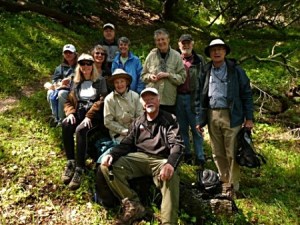
The Danville Area Senior Hikes (DASH) organize hikes twice a month

The Danville Area Senior Hikes (DASH) organize hikes twice a month

“Sixty is the new fifty.” I am sure you have heard this adage. Due to modern medical advances and an increased emphasis upon good health practices in the last three decades, people are living healthier lives.

People are also living longer. The life expectancy at birth in 1950 was 68.2. In 1980, it had improved to 73.7. By 2003, life expectancy figures had stretched to 77.5. Prolonged life supports another trend in the population. Baby Boomers have been merging into the elderly subgroup for seven years now. Census data from 2000 and 2010 reveals a 2.2% increase of adults 60 and over, from 16.3% to 18.5%. Projections indicate that by 2030 persons over 65 will double the number in 2000, to 72 million.

Age 2To the individual dealing with the effects of aging, statistics make little difference. A woman told me the other night that it was downhill after 60. She is 68 and maintains an active lifestyle of aerobics and yoga classes, but arthritis and worn out joints defy resistance. Hair coloring and cosmetic procedures may disguise the onset of geriatrics. Replacement parts may increase mobility. But the body wears out – more slowly for some than others, but inevitably and irreversibly.

I have long enjoyed excellent health. My genetic profile has contributed to a restrained process of physical maturity. Attempts to guess my age usually inflate my self-delusion that aging might be absent from my DNA. A few weeks ago, I met a young pastor at a conference and he asked me if I was enjoying the empty nest. “What are you trying to say,” I snapped back with a smile. He paused and said, “Just that you look very wise.”

I have been thinking that we need a theology of aging. (Boomers think like this. No one else could possibly need it, until we do.) Then I discovered that people have been writing on the subject already. Some of the titles are appealing: The Gift of Years: Growing Older Gracefully, Growing Old Isn’t For Sissies, and You’re Old, I’m Old … Get Used To It!: Twenty Reasons Why Growing Old is Great.

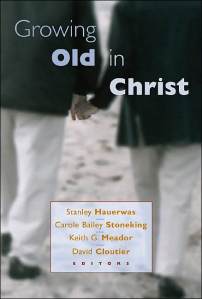
Age 3Growing Old In Christ (Stanley Hauerwas, Carole Bailey Stoneking, Keith G. Meador) was written in 2003 and was the first serious theological reflection on aging. “In a full-orbed discussion of the subject, eighteen first-rate Christian thinkers survey biblical and historical perspectives on aging, looking at aging in the modern world, and describe the Christian practice of growing old.” (from the Book Description on Amazon)

According to the book, loneliness leads the list of characteristics of aging. Friends have died or relocated to an assisted-care facility, creating an absence of any confirmation of identity. Making new friends can lead to superficial relationships that avoid the emotionally draining task of transparency.

Age 4The accumulation of relational losses can embezzle a sense of meaning and purpose. Staying connected to modern society requires energy, stamina and adaptability, qualities that dissipate with age. This disconnect from a fast-paced culture can leave older adults disoriented and wondering what contribution they could possibly make to younger people.

The writers of Growing Old in Christ argue that the Church resides in the Christian story. A story builds on a succession of events and past events play critical roles to the present and future. Older adults provide the memory for the Church, retelling the work of God in previous chapters and relating it to God’s movement in the present. Growing old should translate into growing wise, restraining successive generations from straying from the story.

Age 5A society plugged into the latest technology does not value the experience of age. The enthusiasm of youth does not guarantee clear-sighted direction. Hauerwas contends that “there is no substitute for some old people in the church being wise. Someone must know how to tell the stories well.” Without them, the story can mutate into something very different from Christ and his gospel.

Youth also need models of virtue. Older adults should never allow a retirement culture to entice them into a retirement strategy for the spiritual life. It is not in the plan. Growing old still means growing. Aging should polish the gems of a well-lived life so that they shine even brighter. People always need to be loved. Sinners always need the redemptive message. A lost world always needs demonstrations of the life of Christ and his kingdom.

My favorite model for aging is Caleb. This man first entered the promised land with eleven other representatives of Israel. When the twelve returned only Caleb and Joshua reported to Moses that they could take the land as God had promised. The other ten men said the armies and giants of the land would repel any invasion and wipe out Israel’s army.

Forty years later, when Joshua led Israel into Canaan, Caleb’s faith had grown with his age. Now 85, he appealed to Joshua, “I am still as strong today as I was in the day that Moses sent me; my strength now is as my strength was then, for war and for going and coming. So now give me this hill country of which the Lord spoke on that day, for you heard on that day how the Anakim [giants] were there, with great fortified cities. It may be that the Lord will be with me, and I shall drive them out just as the Lord said.” (Joshua 14:11-12)

May his tribe multiply in our generation!

Posted in Aging, Spiritual Formation, The Church - the Body of Christ | Tagged , , , , | Leave a comment