LOVER OF STRANGERS

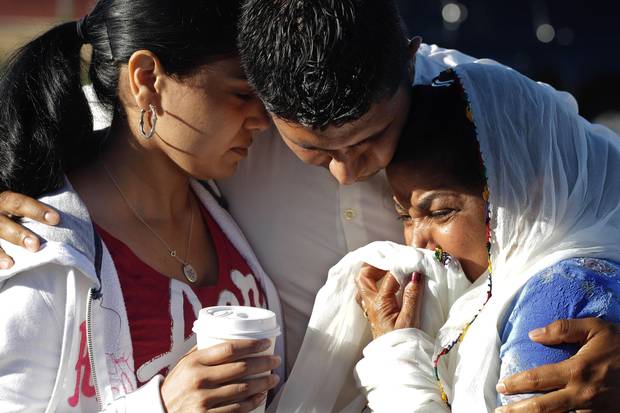
Amardeep Kaleka, whose father was killed by a gunman in the Skih Temple in Wisconsin, comforts other mourners

Only three weeks ago Sunday, a neo-Nazi white supremacist, Wade Michael Page, used a 9 mm semiautomatic handgun to kill six worshipers and wound four more inside a Sikh temple in Oak Creek, Wisconsin, a suburb of Milwaukee. One day later, a Muslim mosque burned to the ground in Joplin, Missouri, a month after another fire at the same mosque was extinguished. Officials suspect arson, although no one has been arrested. Four days later, a neighbor to a Muslim mosque in Morton Grove, Illinois (suburb of Chicago) fired several shots from a pellet gun at the building. Muslims inside the packed facility were completing the final day of Ramadan. The incident capped a series of hostile acts towards the congregation.

It would seem that our turban- and scarf-wearing neighbors also bear a target on their backs and their places of worship. Violent attacks may be limited to the crazies in our society, but this will do little to restore peace of mind to these religious minorities. After all, how many crazies roam our streets?

The remains of a mosque that was destroyed by fire in Joplin, Missouri – officials suspect arson

I am currently a resident of Morton Grove and Joplin, Missouri is my hometown, so I read the reports of these crimes with a certain degree of shame. Joy replaced my shame today when I learned that Joplin residents reached out to their victimized neighbors, organizing a rally Saturday night. Donations to a rebuilding fund have reached $406,000, well in excess of the $250,000 needed for the project.

The Joplin rally displayed the true meaning of hospitality. Dictionaries trace the English word back to Middle English and Middle French in the late 14th Century. It evolved from a 13th Century word that meant to house and care for the needy, our word “hospital.” A related word that meant to house guests developed into our word “hotel.”

The concept of hospitality existed millennia before the evolution of these words. The New Testament writers used a word that literally means, “lover of strangers.” Paul urged the believers in Rome, “seek to show hospitality” (12:13). It is coupled with the exhortation to “contribute to the needs of the saints.”

Most people, when traveling, lacked the ability to pay for the few inns that existed in the first-century world. Christians had the opportunity to demonstrate the mark of God’s kingdom in a tangible way by offering to house overnight guests who would have to sleep on the ground otherwise. Followers of Jesus should treat all of their physical resources as tools that God has entrusted to us to bring relief and refreshment to others, in either “hospitals” or “hotels.”

Morton Grove mosque was the target of a neighbor with a pellet gun.

The Christian community should lead the way in offering this kind of hospitality to the strangers among us, even, especially the religious strangers. A Joplin church illustrated such hospitality when it invited the mosque members to use their building to host the iftar dinner, eaten communally at the end of each day during observance of Ramadan.

Historically, the Church has close identity with the prejudice leveled against these worshipers from the Middle East. Rome aimed its fear and animosity at the new religious sect known as the Way, rounding up Christians as a blue plate special for lions in the Coliseum. The brutality brought cheers from the savage citizens who attended the entertainment.

Persecution against Christians still litters the world today. Because of their faith in Jesus, many believers are tossed into the streets by their families or hauled into prison by local officials. In some countries, hostile crowds, often incited by the dominant religious group, harass believers, sometimes to the point of murdering them.

Jesus did not allow for this kind of hatred and religious superiority among his followers. When a Samaritan village drove away Jesus and his band, John and James suggested an act of religious justice. They wanted to call fire out of heaven on the village, in the tradition of Elijah’s encounter with the prophets of Baal and God’s judgment on Sodom and Gomorrah. Luke 4:55 simply says, “he turned and rebuked them.” Such action does not characterize the good news of a kingdom that brings liberty to the captives and freedom to the oppressed.

Members of a Sikh community in California hod a vigil for those who were killed in Wisconsin.

In a glaring contradiction of current religious practice, Jesus taught new core values for his kingdom. “You have heard it was said, ‘You shall love your neighbor and hate your enemy.’ But I say to you, Love your enemies and pray for those who persecute you, so that you may be sons of your Father who is in heaven.” (Matthew 5:43-44)

Those who worship at a different altar than us do not qualify as our enemies. For many of us, they are literally our neighbors. We should reach out to them with the love that reflects the Lord of our kingdom who loves the world, without exception. And for those who experience the angry outbreaks of the crazies, they especially need a display of the hospitality of Christ’s kingdom, an act of love for the stranger. What an opportunity!

Posted in Love | 3 Comments

FREE TO BUILD BRIDGES

Occasionally one of my children suggests that we go to Chick-fil-A for lunch after church. Oops. Not one of the over 1,600 restaurant locations are open on Sunday. The founder, Truett Cathy, incorporated this practice as one of the chain’s values when he opened the first store in 1967 in Atlanta.

As a devout Christian, Cathy implemented other biblical principles to guide his operation of the restaurant. Those principles are applied throughout the chain as part of its corporate culture. Those who work for the company discover an environment of support and encouragement for the employee and respect and service for the customer that eludes many corporations today.

Not all of their principles or values win the popularity that their chicken sandwiches have. Dan Cathy, Truett’s son and successor, recently made a comment that earned media censure. It began with an interview in the Biblical Recorder on July 16. In reply to a question asked by Allan Blume, Cathy said, “We are very much supportive of the family – the biblical definition of the family unit.”

A radio program, “The Ken Coleman Show,” later pushed Cathy for further explanation, to

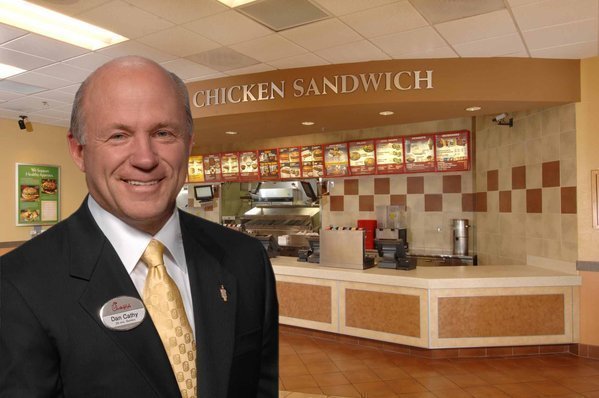
Dan Cathy, president of Chick-fil-A

which he replied, “As it relates to society in general, I think we are inviting God’s judgment on our nation when we shake our fist at him and say, ‘We know better than you as to what constitutes a marriage.’ I pray God’s mercy on our generation that has such a prideful, arrogant attitude to think that we should have the audacity to try to redefine what marriage is all about.”

That germinated a media attack by heavy weights such as The Los Angeles Times with the headline, “Chick-fil-A’s anti-gay marriage stance triggers online uproar.” The Washington Post headlined its story with the question, “Will you continue to eat at Chick-fil-A?” The country’s largest gay activist group, the Human Rights Campaign, skewered the company on its web site, posting a fake tag line under the company’s logo, “We Didn’t Invent Discrimination. We Just Support It.”

True to the shame of Chicago politics, both Mayor Rahm Emanuel and city alderman, Proco “Joe” Moreno, launched an offensive with imprudent and juvenile rhetoric. Mayor Emanuel claimed, “Chick-fil-A’s values are not Chicago values.” Really? Can someone send me a copy of the city’s core values statement? I would like to see that in writing. Maybe I am overly sensitive, but that sounds very much like an anti-Chick-fil-A attack that might be construed as … I hesitate to say this … hate speech.

Proco “Joe” Moreno, Alderman of Chicago’s 1st Ward

Moreno took the assault to a new level. He declared, “If you are discriminating against a segment of the community, I don’t want you in the 1st Ward.” Calling Cathy’s position, “bigoted” and “homophobic,” he promised to use aldermanic privilege to block Chick-fil-A from building a restaurant in 1st Ward’s Logan Square. The company has already acquired zoning, but awaits City Council approval for land acquisition. Moreno quipped, “You have the right to say what you want to say, but zoning is not a right.”

It appears that discrimination is unacceptable, unless it is used to censor those who oppose current definitions of political correctness. Moreno has elevated disagreement to bigotry and debate to malice. Many of the gay community disagreed with Moreno’s threats, but Moreno has yet to call them bigots.

The Christian community has not exactly endeared itself to the society. Too many outspoken self-appointed prophets have confused the disapproval of homosexuality with the castigation of homosexuals. Their speech begs for the seasoning of grace and love, which characterized Jesus in his public discourse.

Jesus warned that the world would hate us, but for reasons apart from our character. The world will always oppose the truth, especially when it challenges cherished beliefs and practices. This does not excuse bad behavior. It does not justify spiteful speech. It does not legitimize arrogance. The world should hate us for what we believe, not for how we say it or display it.

Cathy was not guilty of such conduct. He simply stated a belief based on his interpretation of Scripture. He denounced an attitude that he attributed to society, but if he rightly assessed our culture, the Bible condemns that very attitude. He unapologetically positioned his beliefs in a religious framework. He opens the door for public debate, but not public denigration.

The response to Cathy’s beliefs demonstrates the kind of vitriol faith can generate. This is tame compared to countries where the government opposes Christian beliefs with impunity. Open persecution often results in the death of faithful adherents of the Christian faith.

In our country, where the Constitution protects the practice of religion and speech, followers of Christ should strive for a winsomeness to our lives. We can practice our faith without fear of persecution. Let’s use that freedom to the gospel’s advantage, not as a weapon for battle, but as a tool for construction. Let’s build bridges whenever possible, over which the gospel may pass freely with grace and compassion.

Posted in Civility, Homosexuality, Speech, Tolerance | Tagged , , , , | Leave a comment

IS GOD TO BLAME?

The Century theater in Aurora, Colorado was the site of a mass shooting on July 20, 2012.

The internet buzzed with theological debate last week in response to the shooting rampage of James Holmes in an Aurora, Colorado movie theater on July 20. Holmes’ barrage of bullets left 12 dead and 58 injured.

Shortly after the midnight showing of “The Dark Night Rises” began, Holmes entered an emergency exit and released a canister of gas, believed to have been tear gas. Equipped with a gas mask and bullet-proof vest, Holmes began randomly firing a shotgun into the audience. When it was empty, he dropped it and continued his terrorism with an AR-15 assault rifle.

The incident occurred only 18 miles from the site of a former massacre in April of 1999, when Eric Harris and Dylan Klebold killed 13 people and wounded 21 others at Columbine High School in Littleton.

“If God is good, loving and merciful, then how could he let this happen?” That question reverberates in the minds of many people in the wake of tragedy. Whether one dies or 230,000 die (2004 India Ocean earthquake and tsunami), people inevitably question the character of God.

This inquiry emerges from several assumptions: that God must have power that supersedes man’s, that he can override man’s choices, that his love should compel him to intervene to prevent these kinds of tragic events. If he does not, then either God lacks one of more of these assumed characteristics or he does not exist at all.

Such conclusions are premature without exploring many other questions. How do we explain the existence of evil? What is the nature of man? Why are some people more wicked than others? Can we define a universal morality? What is God’s relationship to humans and the creation?

The answers to these questions have coalesced into many different theological systems. Sifting through the coherence of these systems demands an intellectual rigor that frightens most people. Many simply conclude that God does not exist, but this will not satisfy most of the questions surrounding the nature of man and the presence of evil. Others decide to live with the ambiguities. (The former is atheism; the latter is agnosticism.)

Eric Harris and Dylan Klebold during their rampage at Columbine High School

Most theological systems sputter somewhere in the attempt to answer these questions consistently. At the risk of sounding dogmatic or conceited, I believe Christianity offers the only cohesive and coherent framework for explaining these issues.

God is good in the most absolute sense we can imagine. This goodness precludes any act of evil by him. Jesus said, “No one is good but God alone” (Luke 18:19). James wrote that “Every good gift and every perfect gift is from above, coming down from the Father of lights with whom there is no variation or shadow due to change” (1:17). All of Scripture supports this notion.

God cannot be the ultimate cause of evil. He does not capriciously kill people. Every instance where God brings about death in the Bible, he acts consistent with justice. Perfect justice can never be evil.

If any human dies unjustly, then God could not have caused it directly.

God is sovereign in the most absolute sense we can imagine. No power or authority exists equal to his, much less superior. Jesus said, “With God all things are possible” (Matthew 19:26). In Daniel we read, “all the inhabitants of the earth are accounted as nothing, and he does according to his will among the host of heaven and among the inhabitants of the earth; and none can stay his hand or say to him, ‘What have you done?’” (4:35) The psalmist wrote, “he does all that he pleases” (115:3).

If evil exists, and if God has power over everything, it seems to follow logically that God must be responsible for evil. But what if God created a creature with the ability to make morally responsible choices? And what if God allowed that creature to exercise volition without coercion or control? This would at least explain the coexistence of a sovereign and good God with beings capable of acting contrary to that goodness.

Seung-Hui Cho, assailant in Virginia Tech massacre killed 32 and wounded 17 students April 16, 2007

Being moral creatures, every human has some sense of moral rightness. The standard may vary from culture to culture or from person to person, but most all agree that the social order needs to be ruled by some moral code. When someone acts contrary to that code, humans also sense a responsibility to condemn the action. Thus, the outpouring of judgment on Holmes’ wicked act, as well as, the inclination to criticize God.

But if God is truly sovereign, can he not prevent any unjust act? He can, but that would also interfere with human choice. God would have to stop every human act of evil, which would nullify human moral responsibility.

James Holmes acted in compliance with full responsibility for his moral choices. He chose to commit an evil act. His choice did not compromise God’s goodness or his sovereignty. Holmes’ act deserves just condemnation, which will result in penal consequences to him. God remains blameless for this reprehensible human act.

Please bear with the brevity of this meager attempt to provide a reasoned explanation for some complex theological questions. A systematic theology will provide a more thorough examination of these issues.

God is good. God permits man to make choices. We can choose good or evil. The choice is ours to make. But the responsibility for the choice lies fully with us also. God cannot be blamed.

Posted in Nature of Man, Sovereignty of God | Tagged , , , , | 1 Comment

CHEERS v TEARS

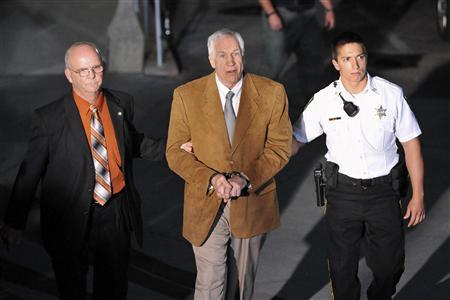
Jerry Sundusky being escorted from court

“Nobody wins. We’ve all lost.” (Spoken by the mother of Vicitm 6 at the conclusion of the Jerry Sandusky sexual abuse trial)

The trial lasted only 10 days. The jury deliberated only 21 hours over two days. The sexual abuse (that was prosecuted) covered 15 years.

The jury convicted Sandusky on 45 of the 48 counts of child sexual abuse. Prosecutors identified 10 boys who were victimized by Sandusky (although many believe there were more).

Judge Freeh denounced the concealment by four top Penn State officials. The crowd outside the courtroom cheered at the announcement of the conviction. The streets and quads on Penn State campus were quiet. Victim 6 wept.

“Nobody wins” could not be truer. The cheering welcomed justice. A man who severely damaged the lives of at least ten boys and their families will receive just punishment for his perverse actions. Although that justice might console the victims, it will not erase the violation or the pain or the trauma of the perpetrator’s evil.

Jerry Sandusky also entered the loser’s column, along with his family and friends. He began losing the first time he failed to resist a deviant sexual desire, when he first defied his conscience and molested a child.

The four university officials lost on the day they decided not to report the witnessed sexual abuse of one of the trusted football coaches. They extended their losing streak each day they remained silent. They multiplied their loss last year when they lied about their actions after Sandusky’s sins became known.

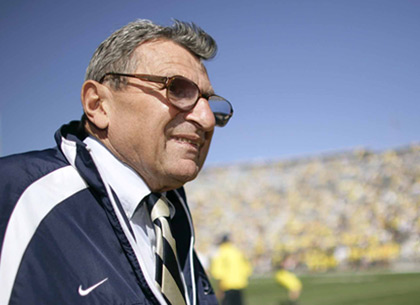
Joe Paterno

One of those four officials who may have lost the most was Hall of Fame head football coach, Joe Paterno, aka JoePa among his ardent followers. Not only does he hold the record for NCAA Division I victories (409), but he also earned the highest respect from players, fans and coaches over his 46 years of coaching. This loss outweighs all those wins.

He lost that respect when Judge Freeh reported, “In order to avoid the consequences of bad publicity, the most powerful leaders at Penn Statute University … repeatedly concealed critical facts relating to Sandusky’s child abuse from the authorities, the Board of Trustees, the Penn State community and the public at large.”

Paterno’s family, former players and supporters deny the allegations, but the evidence strongly supports Freeh’s conclusion. Not only did Paterno choose to ignore the witnesses and hide the facts, he lied about his involvement during an investigation that began in 2010. The Board of Trustees decided to fire Paterno last November, before he could complete the football season and retire. He died two months later of lung cancer. Many believe his statue outside the football stadium should be removed.

“Nobody wins. We’ve all lost.” Sexual abuse victims will testify to the lifelong suffering caused by that one wicked act against them. That same sin defeats the perpetrator, in a different way. Those complicit in the sinful act through their conscious choice to remain silent will suffer enormous loss as well, as indicated by the mangled reputation of a virtual hero.

All pain leaves scars. Scars are manageable. But if wounds go untreated, they can persist as a source of pain and trauma. The losses will only continue to compile as guilt, shame and bitterness ooze out of that wound like the puss from an infected sore.

Repentance and forgiveness. These twin ointments will clean out and disinfect any wound so that it can heal properly, usually with a scar. Repentance means a sincere change of heart, an acknowledgement and contrition of wrongdoing, usually accompanied by sorrow. Forgiveness means removing any personal demand for a penalty, granting a pardon, canceling a debt. These two virtues redeem the losses.

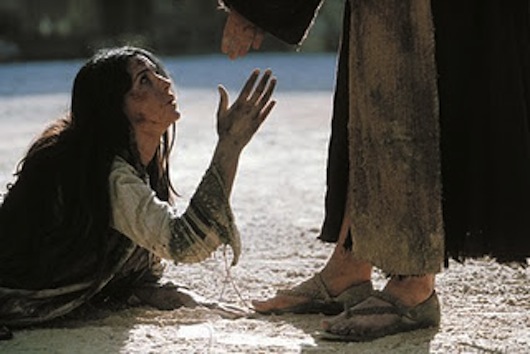
The woman caught in adultery at Jesus’ feet

An angry mob of Pharisees threw a woman into the dirt at Jesus’ feet. Their law exacted the death penalty for her sin of adultery. With stones in their hands, they asked Jesus what he thought. They wanted to test Jesus. He tested them instead. He answered, “Let any of you who is without sin throw the first stone.” Completely befuddled, one by one they dropped their stones and left.

Jesus was not devaluing social law. People who commit crimes must be punished according to the severity of the crime. This is justice. But justice does not reverse the loss. It only penalizes the lawbreaker. It does not fix what is broken or heal the wound. It merely punishes.

Jesus knew that in a fallen world, we need more than justice. We need redemption. And redemption comes through repentance and forgiveness.

Cheers for the verdict against Sandusky echo Pharisaical dispassion. Only tears are appropriate. “Nobody wins. We’ve all lost.” We are not without our own sins – perhaps not as severe, but destructive nevertheless. We need to look in the mirror more carefully before we cast the first stone or applaud a guilty verdict.

Justice may bring some degree of order to a broken society, but it will not bring healing or redemption. Repentance and forgiveness do that.

Posted in Forgiveness, Justice, Repentance | Tagged , , , , , , | 1 Comment

PASSING THE WHEEL

Ten years ago this week, I wrote the following article for our church newsletter. Although the events are a decade old, the message remains ever relevant. Although it deviates from my usual exploration of culture, it seems to be a good time to post it here. It’s a little more personal and not as analytical.

I have the unique opportunity to train two new teenage drivers simultaneously. Chayil was not overly motivated to drive while she was in high school, but she decided to get her license while she is home this summer, at the same time that my sixteen-year-old son, Daka, is taking driver’s ed. Double indemnity.

I don’t know many things that are more frightening than riding in the passenger seat next to a new driver. It makes the Raging Bull at Six Flags seem like a carousel. I have been driving for 36 years now, and I rarely ride shotgun. It is particularly difficult to relinquish control of the steering wheel and pedals to someone who has never operated anything more than a riding lawn mower. They have so much to learn, and they are learning it at the risk of body and limb.

First, there is the issue of wisdom. Not just the rules of the road, which you can memorize from a book. But knowing how to apply those rules in various situations, many of which do not appear in the book. I don’t think I have ever talked so much to my children as when I am trying to impart my experience to them, while clutching the dashboard with white knuckles.

Then there is the matter of judgment. I remember how difficult it was to judge where the right side of my yacht-like Galaxy 500 was in relationship to the road, parked cars, and bicycles. One would think that the smaller cars would be easier to size up. Not so. More than once I have reached over and nudged the wheel to the left to save the tires from the curb, or the outside mirror from a parked car.

And what about judging distances? Isn’t it interesting that in the novice stage there is great confidence in the brakes and little trust in the accelerator. The new driver will sit at a corner for what seems like hours, until there is no car in a one-mile radius, before pulling into traffic (or its absence). Yet, when approaching a car stopped at a traffic light, the opinion seems to be that brakes will stop you in a heartbeat (which I thought was my last on a few occasions.).

And what about speed? The overly cautious neophyte seems to creep along, while frustrated drivers are whipping around him. Then he gets on the expressway for the first time and discovers the exhilaration of power under that hood. The next thing you know, you are reading aloud every speed limit sign as you pass it. (Of course, part of the problem is that the young driver is so intent on keeping the car between the two lines that he doesn’t even notice the signs or the speedometer.)

I think the greatest difficulty for me is giving up control of the car to someone else. It is very uncomfortable for me to allow another person to determine my destiny. I am much more confident in my wisdom, my judgment, my command of this powerful and dangerous technology.

It has caused me to try to imagine what it must be like for God to turn over the management of the universe to such frail creatures as humans. To Adam and Eve God delegated dominion over the entire creation (Gen. 1:26, 28), and He has never retracted that assignment, in spite of the debilitating effects of sin on His fallen managers. Then He entrusted His kingdom mission to His regenerate children, to propagate His gospel and oversee His Church (Matt. 28:18-20; 2 Cor. 5:20). To us! Foolish, weak, depraved balls of dust. Impudent and impotent.

From this perspective, Jesus’ words to His disciples in John 15:5 shout for our attention, “apart from Me you can do nothing.” If we try to drive our vehicles without a helpless dependence upon Jesus we will find ourselves in numerous accidents. How different it is knowing that Jesus is not passively riding in the passenger seat, but is talking us through the process, gently steering the wheel and depressing the brakes for us when we need it.

By the way, both of my children are rapidly, and commendably, progressing in their driving skills. (I just hope they have a better record than I did in the first five years.)

I am so glad that I am not without Jesus, that his Spirit guides and empowers me for the kingdom mission, that I can cry out to him in any situation and he hears, that I can never mess up so badly that he will stop loving me, that he encourages me to keep going and carries me when I am too weak to walk or to foolish to see. Without him, I would be helpless.

Posted in Faith | 1 Comment