WHAT THE INTERNET TELLS US ABOUT OURSELVES

“Tomorrow is Saturday, and Sunday comes afterwards.” No, these are not the lyrics to a Sesame Street original. These enlightening words emerge from the YouTube music video sensation, “Friday”, which many have labeled “The Worst Song Ever.”

Rebecca Black, a cheerful, composed and winsome 13-year-old performs the song, written by Patrice Wilson, founder of Ark Music Factory, a studio that assists young talent to pursue their musical dreams. With the $2,000 to $4,000 fee, Ark provides an original song, studio time, musical video, photo shoot and promotion. Wilson stipulates that his clients must dedicate themselves to music, not to fame.

Rebecca Black in interview on "Good Morning America"

“Friday” began to attract notice very quickly, but not for the reasons Black would have liked. The views on YouTube topped 97 million only two months after it was uploaded. Although “Friday” is a long way from Justin Bieber’s number one video, “Baby,” at 500 million views, it surpassed “Baby” as the most disliked video on YouTube, attracting over 1.9 million dislikes. “Baby” was uploaded in February of 2010.

Comments range from critical, “terrible song, terrible voice, horrible lyrics and horrendous video,” to hostile, “WORST song ever. the first time i heard this song i frantically looked for a gun to shoot myself..worst part this girl lives in my hometown..she should move. cannot stand this song,” to hateful, “I hope you cut yourself,” and “I hope you go cut and die.” In an interview with ABC’s Andrea Canning, Black admitted that the comments really hurt at first. Now she smiles and says that they really don’t bother her any more.

Rebecca Black

Most people agree that listening to the lyrics is like wading in the kiddie pool. And the melody rarely displays much variety, sometimes stuck on the same note like a scratched vinyl recording. The song fails to showcase the young singer’s voice, which is really quite pleasant. All of this hardly warrants the caustic and cruel attacks Black has received.

One has to wonder about a cyber community that invites and facilitates acrimonious speech. The anonymity of those who comment plays to the dark side of human nature. Meanness does not require accountability. One can make unpleasant and painful comments without being confronted, except by another anonymous comment. This provides the darkness where sinful behavior loves to hide.

Even when people do not remain anonymous, cyberspace fosters a pseudo sense of security. Typing to a computer screen mimics private thoughts, masking the relational nature of the comments. People demonstrate a kind of courage to say things they would never say to a person’s face, with little attention to the potential damage of the hurtful comments. Cyber bullying captured media attention when it was linked to several suicides.

This phenomenon has roots in the practice of gossip. This form of sinful speech disseminates information about a person to other people without that person’s permission. It usually chooses more lurid or shocking facts that would damage a person’s reputation. The comments are not directed to the subject of the gossip, but to someone else, creating that same false sense of security that cyber space offers. Gossip has the same effect as cyber comments, but not the same scope.

So why do humans feel the need to post nasty comments, cyber bully or gossip? Reasons might include jealousy, envy, insecurity, low self-esteem, pride and dozens of other character flaws. In the final analysis, they demonstrate a lack of love and kindness.

This does not mean truthful comments that might be hurtful should never be posted. The internet creates a forum for the free exchange of ideas and wrong ideas need correction. But love would not allow correction to occur at the expense of the person. In truth, correction should be done for the benefit of the person.

Paul advised that truth should be spoken in the context of love (Ephesians 4:15). If love monitors the communication of truth, consideration for the needs of the person will direct and control every comment. If the truth might bring pain, it would be expressed only if the pain is necessary for the person, like a surgeon’s scalpel that produces pain to save a life. Conveying that truth with no regard for the person, his feelings, his reputation, his family, his sense of worth or identity, wields truth more like a soldier’s bayonet that only injures.

“Love is patient and kind; love does not envy or boast; it is not arrogant or rude. It does not insist on its own way; it is not irritable or resentful; it does not rejoice at wrongdoing, but rejoices with the truth. Love bears all things, believes all things, hopes all things, endures all things. Love never ends.” (1 Corinthians 13:4-8)

The internet does not create incivility. It only reveals it. And incivility exposes hearts where the damaged and absorbed self has displaced love.

Posted in Bullying, Character, Culture, Love | Tagged , , , , , , , , , , | Leave a comment

A VERY PRESENT HOPE

Protest in Egypt

As we enter this Easter season, we are observing a political upheaval of global proportions. From protests to armed conflict, citizens of Bahrain, Tunisia, Yemen, Jordan, Egypt and Libya seek to remove oppressive governments and replace them with political systems that provide more equity and justice.

The vast majority of people in these countries practice the Islamic faith, a faith that has a well-developed theology of a glorious and blissful afterlife. Muslims anticipate a resurrection of the dead on the Last Day, when God will judge all humans. If a person lives a good life, he enters Paradise. If his bad deeds overshadow his good deeds, he is sent to hell. In the ensuing time between death and the resurrection, the soul remains in the grave, where it begins to experience its final destiny of hell or Paradise.

Protest in Libya

Most Muslims are not without hope in their eternal destiny. Most live faithful to the rules of the Quran, expecting to enter Paradise in the resurrection. Some do suffer uncertainty and guilt due to their work-centered faith, but that is not the focus of our thoughts here. Most have hope in their afterlife.

That hope is not enough to sustain the Muslims in the countries of current unrest. They want a hope in this life. They want freedom and justice of some sort – more than they are experiencing. They want to depose cruel or heavy-handed rulers. They need to believe that life can be better now, not just in eternity.

Christ-followers also believe in a resurrection of the dead to judgment, but we offer a better strand of hope. We believe the soul immediately passes to a temporary residence to await the final judgment, either to Heaven in the presence of God or to hell, a place void of God’s presence and glory.

For many Christians, the hope of heaven fully summarizes the benefit of Jesus’ resurrection from the dead. Conquering death, he secured our justification before God, guaranteeing God’s forgiveness of our sins and our final salvation from God’s wrath at the judgment. For many, Jesus’ resurrection does not extend beyond the assurance of our eternal destiny.

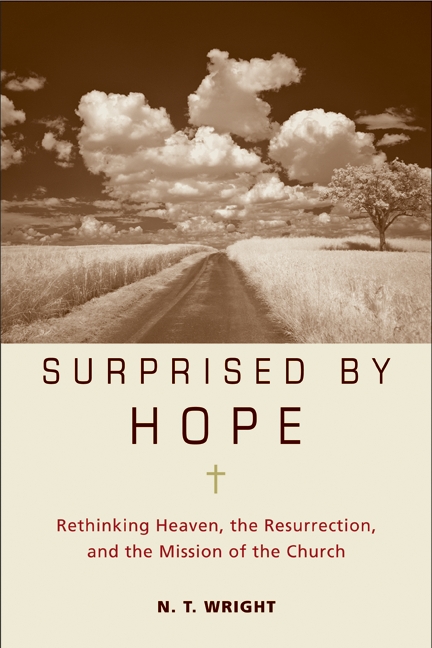
First-century Christians knew no such limitation. As New Testament scholar N.T. Wright puts it, “Insofar as the event is interpreted, Easter has a very this-worldly, present-age meaning: Jesus is raised, so he is the Messiah, and therefore he is the world’s true Lord; Jesus is raised, so God’s new creation has begun – and we, his followers, have a job to do! Jesus is raised, so we must act as his heralds, announcing his lordship to the entire world, making his kingdom come on earth as in heaven!” (Surprised By Hope)

The resurrection of Jesus means that life in twenty-first century America can be very different than it is. The resurrection was the initial act of God to recreate this fallen world. You experience that recreation every time you say “no” to your sinful desires and “yes” to the prompting of the Holy Spirit, the down payment of your inheritance. As we live under the lordship of Jesus, God unleashes his power in and through us, the same power that raised Jesus from the dead (Romans 6:5). This recreation can extend to all the broken parts of your life as the resurrected life of Jesus empowers you to experience the kingdom life now, in a broken world.

This does not mean that you will live a life free from pain or opposition. This freedom will occur only in the final form of God’s kingdom. In the meantime, we still wrestle with spiritual powers (Ephesians 6:12). We still suffer the effects of living in a fallen world with bodies that are susceptible to sin (1 Peter 4:12). We must persevere in hope of that final phase of the kingdom, enduring hardship to the end.

Our hope is not confined to the afterlife only, but we also hope in this life. Even in suffering, we can know the joy and the power of Christ, as his resurrected life is infused into us through his Spirit in us.

Jesus is not dead! He is alive! This means that you do not have to wait for God’s salvation in the promised future, but you can live now as “more than conquerors through him who loved us” (Romans 8:37).

Posted in Hope, Resurrection of Christ | Tagged , , , , , , , , , , , , , , | Leave a comment

AN EXPLANATION OF SORTS

A boat, washed inland by the March 11 tsunami, lies next to a surviving house amid the ruins of Ofunato, a fishing city in Iwate prefecture, northeast Japan.

The death toll in Japan continues its climb, inching past 12,000 with 15,000 still missing. Like all natural disasters, the earthquake and tsunami indiscriminately snuffed out human life, killing elderly and children, male and female, wealthy and poor, educated and uneducated.

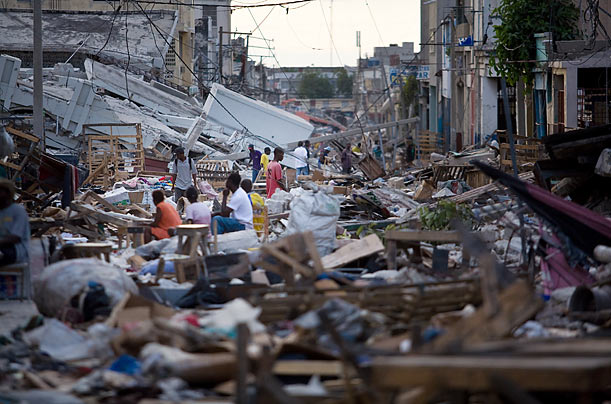
The number of casualties pales in comparison to last year’s earthquake in Haiti (222,000) or the 2004 Indonesian earthquake/tsunami (230,000) or the 2008 Myanmar cyclone (146,000). In only a few horrifying minutes, hundreds of thousands of humans stopped breathing and abruptly exited the stage of life.

Devastation from the Haiti earthquake in 2010

Natural disasters appear to operate outside any system of justice. Serious questions scream for answers after watching innocent victims unfairly selected by an impersonal executioner for punishment. In the aftermath of these tragedies, God is inevitably dragged before a grand jury and indicted on charges of being unjust, unloving, capricious and cruel, if such a God who rules over the creation can even be found to exist.

If such a God does exist, is he really subject to human judgment? How can we criticize or condemn a God who created us and exemplifies the perfect standard of every virtue revered by humanity? To do so requires that we hold God to our standard of virtue rather than being held to his standards. In reality, we make ourselves god over God.

We can judge him, only if we make God into a god. To be God means to be greater than all others, a Supreme Deity, the Sovereign Judge. No one can be his equal. He cannot be like any other being or he then becomes a god. Such a god may be greater than humans in certain areas, but becomes our equal or inferior to us in other areas. We can question his virtue because we believe human understanding of virtue establishes the benchmark.

Believing God exists creates a problem, because he is not available to our physical senses. We cannot observe his activity. We cannot call him in for questioning. Is God directly responsible for natural disasters? Or does some other invisible force or power exist that

Tsunami advance on Indonesia in 2004

can unleash its cruelty on humans at will? If God does not have authority over this hostile force, what does that mean for the future of humanity?

This raises the question of knowing. How do we know anything about a reality that we cannot access through the physical senses? Knowledge of God, or god for that matter, depends upon the deity communicating himself to humans in a way that we can know him. We depend entirely upon his self-revelation. Of course, if he does not meet the requirement of integrity, we cannot rely on him to honestly reveal himself.

The God of the Bible claims to have given a revelation of himself to his creatures. He claims to be a God of love and justice, not compromising one for the other. He claims responsibility for many events in history that seem harsh or even cruel to human sensibilities, but he declares that they violate neither his love nor his justice. He does not try to alter the record of these events to comply with human political correctness. Instead, he demands that humans search the revelation diligently to know who He is.

The ancient revelation gives some explanation to these disasters. God created man. In fact, he made the human creature in his own image, so that humans have the capacity to act with many of the virtues God possesses. The image-bearing creatures rebelled against God. Another invisible being appeared to one of the first humans and convinced her that she could obtain a status equal to her creator. It required that she disobey God. The first humans chose the path of treason, believing that disobedience to God would make them god.

Justice demanded punishment. Love softened that punishment. On that day, death entered the creation. Death is the just punishment for rebellion against a holy God. God postponed death for his image-bearers in order to allow for redemption. God has a plan to rescue his beloved creatures without compromising his justice.

The punishment included the opposition of the creation to humanity’s existence in it. God placed the entire creation under a curse. Humans must subdue the creation to make it receptive to their existence. Nature does not cooperate willingly with human efforts of control. Natural disasters are one of many ways creation demonstrates this opposition.

In the final analysis, humans do not deserve to be alive at all. Our acts of rebellion against a holy God abound. We disregard his law with impunity. We dishonor him and his authority with audacity. We discard his self-revelation with stupidity. When anything goes wrong, we foolishly accuse him of evil. Blinded by our pride, we attempt to be god by reducing God to god.

I don’t pretend to fully understand the horrific tragedies in Japan or Haiti, but I believe that God acts within the parameters of his virtues, including love and justice. I plead creaturehood, meaning I do not have the ability or authority to question God. Job tried it and God quickly put him in his place. We need to remember that place and pursue the knowledge of God through the revelation he has given of himself to his image-bearing creatures.

Posted in God and Nature, Natural Disasters, Suffering | Tagged , , , , , , , , , , | Leave a comment

THE LIFE OF JANE

Jane (not her real name) agreed to meet with Christian Smith for an interview because she needed the incentive money offered for the interview to finance a trip she had planned that weekend. Smith was working on his newest book, Souls in Transition: The Religious & Spiritual Lives of Emerging Adults, follow-up research on his earlier work, Soul Searching: The Religious and Spiritual Lives of American Teenagers. Soul Searching targeted young people 13-17 years old, while the recent study tracked 18-23 year-olds.

Not yet 20, Jane is already divorced, a mother and a recovering drug addict. Her parents divorced when she was young, and her mother suffered a debilitating aneurism when Jane was only 12. She has had to serve as a part-time caregiver, not only to her mother, but also to her grandmother, who lives with them.

Jane’s first encounter with marijuana came at age 11 and she drank alcohol for the first time at age 12. By age 14, she was smoking marijuana regularly along with cigarettes. By age 17, she had advanced into a heavy drinker. She adds to the list of drugs she has consumed, “I’ve tried coke, morphine, heroin, Lortem, Xanax, Klonopin, crack, meth. When I was 15 I did it for the first time. When I was 16, I did meth for a couple of months, and then I never have done it again.”

While she was on a three-month alcohol binge at 17, she met her ex-husband, Nick, and got pregnant while she was drunk. When she realized that she was pregnant, she gave up alcohol and hard drugs for her baby. (She still smoked pot because she did not consider it harmful.)

Jane dropped out of high school in tenth grade. “That happens a lot around here, we have a very high rate of dropouts.” She worked at the Dairy Queen for a brief time. Now she earns money by providing a taxi service to her friends, who pay her for rides. Regretting her decision, she took the GED and scored so high that she won a $3,000 scholarship to the school of her choice.

Sexually active at the age of 13, Jane has lived with six different men. After dating Nick for a short while, he gradually moved in with Jane at her mother’s house, with reluctant approval. They got married after Jane became pregnant, moving back and forth between their parents’ houses.

Nick became abusive. It began with a slap, pulling her hair or twisting her ear. It progressed to choking her until she passed out, which became a recurrent practice. She would leave him, but always came back. A counselor she talked with reported Nick and the state took their infant son away. Jane filed a restraining order against Nick.

Jane’s life revolves around regaining custody of her son, Ben. She entered a drug rehab program, after failing a drug test. She divorced Nick because the state required it, in order to regain custody of her son. She has not pursued college or the scholarship because she has devoted herself to navigating the legal maze of the child welfare system.

Jane still has difficulty sorting through her life. Since losing Ben, she lived with another man for a couple of months, with whom she still hangs out occasionally. And she continues to meet with Nick, although they must be covert about it, since it violates the state’s terms for recovering Ben. She admits that they had been drinking margaritas at the restaurant the night before the interview. The tragic irony is not lost on Smith.

Smith probes to understand Jane’s moral base. Her grandmother took her to church twice when she was young, but she has no real knowledge of religion. She does pray, but she does not know to whom she makes her petitions, asking to get Ben back. All of her friends are like her. When Smith asks what she thinks about religion, she replies, “Who cares, really? Not relevant. I never pay attention to churches really at all.” She admits a willingness to give her life to God, if it would mean getting custody of Ben, but she would not know where to start.

When Smith asks about morality, Jane responds, “I think I have a pretty good sense of what’s right or wrong. I think I just picked it up along the way more than anything.” So Smith asked if she considered it easy or hard to do the right thing. “It’s easy. I don’t like to do wrong because I believe in karma…. I’ve always believed in karma, because I can remember times when I’ve done the wrong thing and lots of bad things have happened.”

How does Jane determine what is right or wrong? “I guess it’s all in my head, whatever I happen to justify….” And how does she decide about what to do when she is uncertain or confused? “Whatever situation I’d be in, whatever decision that would make me happy, that’s what I would go for.”

“In those days there was no king in Israel. Everyone did what was right in his own eyes,” Judges 21:25. Jane illustrates the moral climate when there is no moral lawgiver or judge. You comply with human legal systems when it is convenient or inescapable. If the law gets in the way of your moral code (your happiness), you use stealth to avoid the law.

Although Jane does not represent all emerging adults, Smith found that the percent of those who identify themselves as nonreligious went from 14 percent among 13-17 year-olds to 27 percent among 18-23 year-olds. In only five years, the number of irreligious people nearly doubled in this age group. The trend should concern all of us.

“And how are they to believe in him of whom they have never heard? And how are they to hear without someone preaching?” Romans 10:14

Posted in Culture, Morality, Teens | Tagged , , , , , , | Leave a comment

VIRTUOUS?

The “Faceless 50” are receiving international attention for their courage and self-sacrifice. These Japanese workers at the disabled Fukushima nuclear power plant have worked around the clock to contain the fires and prevent a reactor meltdown. This display of character imitates the 186 firefighters who extinguished the fires at the Chernobyl reactor in 1986, 28 whom died of acute radiation sickness the same year. And it reflects the selfless action of the 343 firefighters and paramedics who fatally rushed up the stairs of New York’s twin towers in 2001.

Some observes suggest that the Japanese workers differ from their counterparts in their motivations. The Japanese attribute this unselfish quality to the Yamamoto-damashii, the Japanese spirit. For hundreds of years, the Japanese people have been conditioned to place the group ahead of the individual. Identity emerges from the family, community, company or other collective, rather than from individual personality or sense of personal worth.

This group orientation yields an Age of Aquarius society, characterized by peace and harmony – at least on the surface. Japanese avoid expressing personal opinions and avoid all public conflicts. Social pressure trains them to suppress negative feelings and ill will – better to suffer privately and internally than to threaten the social harmony. This frequently results in unhealthy psyches or toxic grapevines.

Group harmony dictates group decision making. Japanese avoid speaking their minds directly, believing it is impolite. When trying to decide what movie to see, a group will carefully navigate a lengthy series of questions to arrive at a consensus. Not wanting to risk disagreement, several people in the group may conform to the group’s decision with unexpressed disapproval.

Enforcement of these values occurs through haji, or shame. If someone asserts too much independence or individuality, the community would treat him with shame. Being different from the group may result in standing outside the group, something every Japanese person strives to avoid. As a friend once told me, the Japanese are taught from childhood, “The nail that sticks up gets hammered down.” One must walk a very narrow road of extreme deference, severe self-denial and restraint of self-expression.

With great pride, the Japanese defend all these traits, which bear the same names as biblical qualities, such as humility, self-control, meekness, empathy, self-discipline, honor and respect. Yet, Japanese culture has resisted most, if not all, attempts of Christian influence. The group mentality carries such enormous power that it commands highly effective cultural conditioning.

Some explain this value emerged from Japan’s geography. This island group isolated its people from the rest of the world for many years, forcing a greater sense of group dependence. Others argue that Japanese culture must be interpreted through the centuries of feudal warlords who exercised their autocratic will with impunity. The Japanese people were nothing more than servants to these shoguns. To survive, the people developed a strict attitude of submission.

Regardless of its origin, the group mentality did not originate from a Christian influence. This may be an example of Paul’s reference to “Gentiles who do not have the law, [but] by nature do what the law requires …. They show that the work of the law is written on their hearts, while their conscience also bears witness ….” (Rom. 2:14)

Created in the image of God, even fallen humans retain vestiges of that image. They still possess some sense of justice, morality, love, compassion, mercy, humility and other valued qualities. Sin damages that image and pollutes every positive attribute, but it does not erase them. These qualities will still express themselves to various degrees.

What motivates these acts of virtue we cannot say. Did the Russian firemen even know the risk they were taking? Had they known the horrible death some would suffer, would they have still fought those fires? Perhaps some people, like the American rescue workers, simply react instinctively in the face of danger, a reaction that is self-sacrificial, but unconsciously so. Are the “Faceless 50” motivated by fear of shame more than a virtuous love?

Motivations of the human heart may be as complex as human genetic code. This much we do know: A social group can construct itself with the values it chooses to affirm and persuade conformity to those values through cultural conditioning practices. Only when a member of that group embraces a value different from the group, and embraces it with some level of conviction, will that member refuse to conform to the group, accepting the discipline of the group, whatever that discipline may entail.

As followers of Christ, we are called to resist conformity to the world. Our allegiance should be to the kingdom of God and its King above all other allegiances. The values of that kingdom differ from the prevailing cultural values of any human society where we might reside and we should hold them with a conviction that enables us to endure whatever cultural pressure our social group chooses to enforce.

This non-conformity is an act of faith, belief that a better social order does exist and that we will one day enter the purest form of that society forever. “Set your minds on things that are above, not on the things that are on earth. For you have died, and your life is hidden with Christ in God.” (Colossians 3:2-3)

Posted in Character, Culture, Nature of Man, Virtue | Tagged , , , , , , , , , , , , , , , , , , | Leave a comment