DON’T FALL ALONE

Jimmy Stewart and Donna Reed play George and Mary Bailey in "It's A Wonderful Life"

Jimmy Stewart and Donna Reed play George and Mary Bailey in “It’s A Wonderful Life”

My wife recently observed that you can illustrate almost anything from the classic movie, It’s A Wonderful Life.

For example, have you ever noticed how people who are very good in giving support and encouragement to others, tend to suck at allowing other people to support them in personal crises? Their supply of emotional strength and wisdom overflows into the lives of others. When they encounter difficulty, they rely on that supply for themselves, overlooking the value of shared strength.

For these super-givers, the proverb, “Two are better one …. For if they fall, one will lift up his fellow,” only applies when the other person falls.

George Bailey (played by Jimmy Stewart) could not escape the pressing needs of others. His life was defined by personal sacrifices to help others in crisis. He was stuck in a job that smothered his adventurous spirit, but he dutifully sustained his small building and loan company because he recognized the financial, emotional, psychological and social benefits to others.
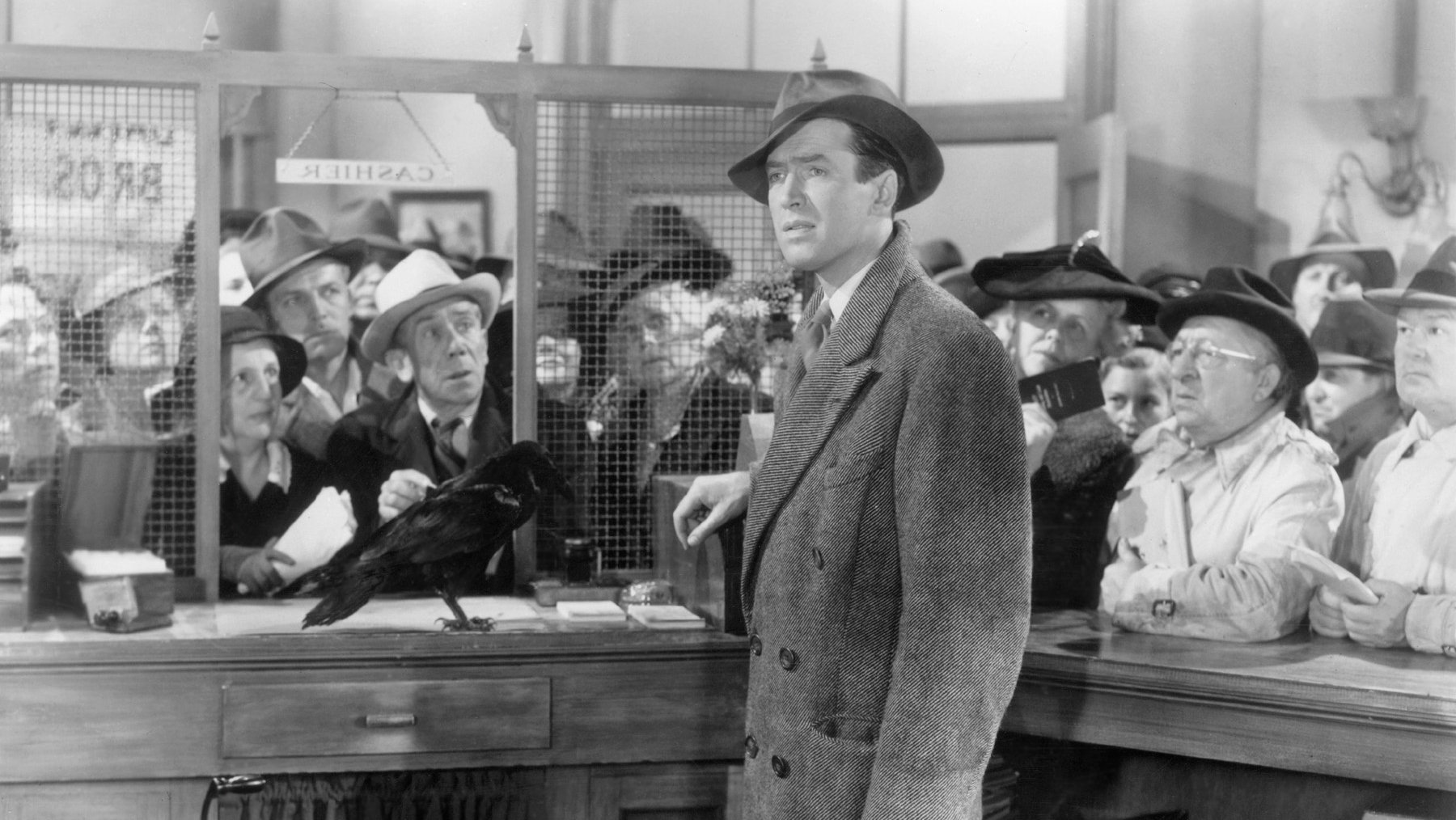
George averts a crisis by appealing to the community principle of the Building and Loan

George averts a crisis by appealing to the community principle of the Building and Loan

As the years added up, his respect in Bedford Falls multiplied. Sometimes he longed to pursue more exciting aspirations, but his sense of responsibility to serve his community and his friends would not allow him to leave town.

Then a simple mistake by his uncle compounded itself into a financial crisis. Before he could make a deposit of $7,000, Uncle Billy (Thomas Mitchell) misplaced it. Hours of frantic searching by George and Billy did not produce the money.

Back at the office, the state’s bank examiner waited to audit the books. George believed that the missing money would lead to a charge of embezzlement. Not only would it wreck his life personally, but it would close the doors of the building and loan, erasing his years of sacrifice to keep the business open and expunging the one place where people were treated with empathy and compassion in their financial struggles.

George plans to jump off the bridge

George plans to jump off the bridge

Did George turn to the community who loved him? Did he seek the support of friends and neighbors he had helped for years? No. He tried to fix his problem privately. With hope spilling out of his life as fast as coffee from an open cup while running to catch the train, George descended to a closeted solution. His death would yield a life insurance claim that would fix his financial problems, but he ignored the social chasm his absence would leave.

You really need to watch this powerful story to appreciate how it unfolds. In the end, news of his crisis spread like fire on a windy day in a water-deprived prairie. People came to George’s aid. George discovered the real value of friends when calamity forced him into a position of need and he allowed others to meet that need.

Our self-sufficient, privatized, American individualism corrupts our understanding of community. This distortion often seeps into our interpretation of the Scriptures.

Take Joseph, for example. God’s grace repeatedly elevated this man out of the pit of affliction to a peak of achievement. In every crisis, Joseph appeared to be alone. He had no support, no community, no friends to lift him up when he fell. But he always got up. His muscular faith enabled him to endure revenge and persecution and injustice without the side effects of bitterness and despair. God had chosen this young man for a mission and no opposition would derail him from succeeding.

The individualist might be inclined to conclude that community may be nice, but not necessary. Joseph survived on his own. Well-toned faith can sustain any person in his private journey, regardless of what obstacles lie in his path. God alone is sufficient. “All I need is God.”

This conclusion ignores the host of passages that assert the importance of community and interdependent relationships. God’s design of the church as an organic body, where parts of the body must work together to sustain life, refutes such a premise. Paul argues, “If one member suffers, all suffer together; if one member is honored, all rejoice together.” 1 Corinthians 12:26

When we choose to act independently, we harm the rest of the body. We may think we are suffering alone (the courageous martyr), but the other parts of the body are suffering as well. They may not know they are suffering, but the isolated member denies their contribution of love and support. Unused muscles atrophy.

Take a lesson from George Bailey. The path of isolation is dark and destructive. Reliance on friends distributes a burden into shared portions.

Combined strength multiplies individual strength. If you fall, you better hope you were not walking alone.


Posted in Community, Individualism, Movies, The Church - the Body of Christ | Tagged , , , , | Leave a comment

WHERE DO YOU FIND REAL COMMUNITY?

“We come from all the divisions, ranks and classes of society … to teach and to be taught in our turn. While we mingle together in these pursuits we shall learn to know each other more intimately; we shall remove many of the prejudices which ignorance or partial acquaintance with each other had fostered. … In the parties and sects into which we are divided, we sometimes learn to love our brother at the expense of him whom we do not in so many respects regard as a brother. … We may return to our homes and firesides [from the lyceum] with kindlier feelings toward one another, because we have learned to know one another better.”

The Lyceum at New Bedford, MA

The Lyceum at New Bedford, MA

Thomas Greene wrote these words in 1829 about the newly built lyceum in New Bedford, MA. New Bedford became one of the world’s leading whaling ports, attracting a diversity of new inhabitants at the turn of the 19th century. The lyceum offered a central location for public gatherings to hear lectures, discuss topics of civic importance and enjoy cultural events that contributed to personal growth.

Greene recognized the common social problem of exclusivism, when people cluster in very small cliques around closely shared interests and experiences. He hoped that the lyceum would expand the sphere of relationships and strengthen the community.

Robert Putnam included this quote in his seminal work, Bowling Alone: The Collapse and Revival of American Community (2000), a sociological study of American communal life. Community in America has suffered the swelling tide of individualism in the last five decades. In general, people are trading communal life for a bloated private life, as they shrink their relational sphere to family and a small group of very close friends.

Alexis de Tocqueville

Alexis de Tocqueville

In his book, Democracy In America (1835), Alexis de Toqueville observed the wide range of communal involvement of Americans. He believed the strong relational connections of these voluntary groups would inhibit selfish pursuits that handicap any society. He especially warned against the encroachment of individualism in a democratic society,

“a calm and considered feeling which disposes each citizen to isolate himself from the mass of his fellows and withdraw into the circle of family and friends; with this little society formed to his taste, he gladly leaves the greater society to look after itself.”

The small church (under 250) dispenses an antidote to individualism, providing a lyceum to a diverse gathering of people. A specific set of beliefs draws a permeable perimeter around the church community, creating a form of an exclusive society. But the small church can offer a rich diversity of communal connections in which meaningful relationships form.

The small church wields this advantage over the more conspicuous megachurch. A megachurch may enjoy a wealth of resources, programs and personnel, but the environment promotes anonymous individualism. Religious consumers benefit from services and programs of exceptional quality, but can easily come and go without personal interactions of any depth.

For example, visitors to Lakeside Church often remark about how long people remain in the sanctuary and hall after a Sunday service, talking with one another. Members of Lakeside value these relationships as important supplements to their worship experience.

Biblical fellowship makes as much of a contribution to spiritual growth as studying the Bible, prayer, witnessing and worship.

In most large churches, the building empties quickly following a service. Multiple services contribute to the impersonal climate, requiring one group of congregants to vacate the sanctuary and parking lot so that the next group can attend. Some megachurches have tried to counteract this trend with the addition of coffee and snack shops outside the sanctuary. Unfortunately, many customers order to go, just like they do on Monday morning.

Many megachurches have discovered the importance of small groups to try to create a place for the formation of intimate relationships. Small groups must carefully structure for the fellowship component or they merely become another Bible study or prayer group. Small groups that schedule gatherings in addition to their weekly meetings have begun to discover the real value of community.

The small church also benefits from small groups, but these relationships are enhanced by additional church gatherings. Not only can people maximize the Sunday experience with meaningful relational connections, but they can nurture those relationships at potlucks and other all-church events. Community develops a broader meaning in small churches than large ones.

Small churches should recognize their advantage in the formation of community where we can “learn to know each other more intimately.” In these small communities we can more effectively “stir up one another to love and good deeds.” (Hebrews 10:24)

Without these communities we may be collapsing into a selfish, individualized spirituality that fails to resemble the New Testament church.

Posted in Community, Culture | Tagged , , , , | Leave a comment

RAISING OUR RELEVANCE QUOTIENT

Should the Church become culturally relevant? This question gets kicked around by Christians. The negative side fears absorption into the world and apostasy from the faith. The positive side fears society’s disregard and the attrition of the Church’s mission.

The current economic crisis has laid cultural relevancy at the Church’s door. Throughout history, the Church has had a reputation for compassion and generosity. Christians took an active interest in the affairs of their communities, particularly in humanitarian causes.

Today’s (11/21) WBEZ program, “Eight Forty-Eight,” addressed a severe problem in the Chicago area. Both the federal and state governments have to reduce their runaway deficits. Both have proposed deep cuts to human services.

Roseland Christian Ministries Center in south Chicago

These cuts have created a crisis for programs like the Homelessness Prevention Program and the Emergency and Transitional Housing Program. HP provides one-time emergency payments on utilities, rent or mortgage to give temporary assistance to a family in crisis. The program gave grants up to $1,000 to 96,000 households last year, helping them avert homelessness. ETH provided emergency housing to over 40,000 people in Chicago last year, enabling homeless people to get off the streets at night.

Illinois’ Department of Human Services projected a $250 million increase to their budget this year to meet escalating needs. The governor’s budget not only ignores the request, but slashed another $150 million from the budget. In 2009, Illinois disbursed $11 million to programs like HP and ETH. Homeless agencies expect to receive only $1.5 million this year. The federal government will no longer accept applications from Chicago agencies for funding.

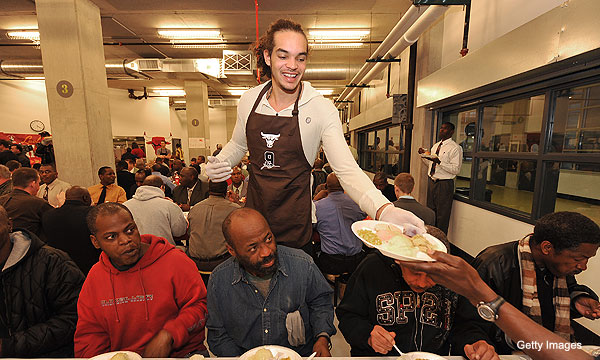
Chicago Bulls’ Joakim Noah serves homeless at Pacific Garden Mission

As the funding dries up, the homeless population swells. In Chicago last year, 93,000 people lived on the streets. Current trends promise more cement inhabitants. Most agencies rely entirely on federal and state funding. Some have already closed their doors and others face grim prospects.

A second basic survival service, food banks, also face a supply crisis, as an article in today’s Chicago Tribune indicates, “Food pantries struggle to do more with less for holidays.” The USDA provided 30.1 million pounds of food to Illinois in the last fiscal year. Authorities expect only 18.8 million pounds this year, a 37.5 percent reduction. Chicago alone expects to see an 8 million pound decrease from the 69 million pounds they distributed last year.

Food costs are exacerbating the problem. The Harvest Food Pantry in Evanston gave out 500 bags of food last Thanksgiving, costing about $5,000. The director expects a 20 percent spike in that cost this year to $6,000. Food prices last month increased by 4.6 percent over the same month last year.

Greater Chicago Food Depository

Greater Chicago Food Depository

The Greater Chicago Food Depository served food to 5.18 million people by the end of its fiscal year, shy of the 5.2 million record between 2009 and 2010. The Depository has received 7,000 pounds of food per month less since the middle of the year. Local food pantries who depend upon the Depository for its supply must look to local contributions to reconcile the deficit.

Voila! The Church’s opportunity for relevance. What is more relevant than basic survival resources? What is more relevant than people’s lives at risk because of fiscally mismanaged bureaucracies? What is more relevant than broken people needing compassionate intervention? And what is more relevant than loving your neighbor through generosity and hospitality?

Some churches entered the social services scene many years ago. Many churches participate through their denomination’s branch of compassion ministries. In spite of the many efforts, the Church’s contributions pale in comparison to the state’s. Now the state has chosen to ignore the critical needs of its citizens. A bureaucracy cannot love its neighbor like an individual can.

Churches face the problem of being paralyzed by the staggering need. Instead of dividing itself into small ministries, the local church would more effectively benefit the community by focusing its energy and resources on one or two local services. Even if a church can offer only a few loaves and a few fish, God can multiply that donation to feed hundreds.

A man walking along the shore one day noticed that a storm had washed thousands of starfish onto the beach. In the middle of this marine crisis, a young boy was picking up starfish and throwing them back into the ocean. The man asked him what he was doing. “If these starfish don’t get back in the water quickly, they will die,” the boy said. “But there are thousands of starfish. In the larger scheme of things you’re not going to make much of a difference to all these starfish.” The boy reached down, picked up another starfish and flung it into the ocean. He looked at the man and said, “It’s going to make a big difference to that one.”

The Church has an opportunity to make a big difference in the lives of millions of people, if Christians will collectively find ways to show biblical hospitality to strangers through acts of compassion. These ministries will raise the Church’s relevance quotient.

Posted in Christians Engaging Culture, Compassion, Generosity, Poverty | Tagged , , , , , , , | Leave a comment

ABOUNDING

When I pulled off the highway into the neighborhood, I knew that I was driving in a place very foreign to me – and possibly unfriendly. Very old, rundown three-flats lined the streets. I noticed that the color of the skin of the few people driving cars or walking on the streets differed from mine.

My friend, Ken (not his real name), led me into the basement through the outside door. I observed a toilet half exposed behind a blanket hanging as a curtain. The odor implied that the curtain partitioned off a bathroom. Ken led me through another hanging blanket into a dimly lit, narrow room. One wall was brick and the wall ten feet across the room consisted of more blankets.

The large television demanded first notice. A small space heater rested on a coffee table between the couch and TV. A toaster sat on a table. Ken opened a small dorm-room style refrigerator for a jug of water. It was empty otherwise.

Ken and his wife welcomed me into their living quarters warmly. I sat on a chair like the kitchen table chairs in the ’50’s, metal with a plastic covered seat. They wanted me to meet a friend. A young white woman emerged through a swinging door at the end of the room, apparently the bedroom. She said she was working on pictures for the couple.

Ken was recently laid off from a construction job temporarily. Good thing. His bronchitis seemed incapacitating. The landlord lets Ken rent the “apartment” for half of the $1,600 fee because he cleans the building grounds. He is behind on the rent. His wife’s favorite uncle died just a few months ago. Her brother died last week during a drug arrest. Reports differ about the cause. They usually do.

But then Ken told me the worst news. Doctors diagnosed him with a brain tumor and gave him a 40 percent chance of survival – if he has the surgery and follow-up treatments. Did I mention that he has no money, or family to help?

You were probably expecting an uplifting Thanksgiving blog. Sorry. God led me out of my suburban bubble last week to see another part of the world, the one I conveniently insulate myself from, even though I can drive there in less than 30 minutes. It seemed worth sharing with you.

God shapes a grateful heart in many ways. Our consumer culture incessantly tells us that we are one purchase away from happiness. Marketers do not nurture contentment, much less gratitude. Sometimes comparisons jolt us out of a fabricated existence. Seeing what I have in comparison to what many others lack humbles me. It exposes how liberally I spend and how miserly I give.

Paul instructed the Colossian believers to walk in Christ the same way that they had received Him (2:6). This means they should live their lives with the same trust in Christ that they exercised when they first trusted him for salvation. Living with this kind of faith is a learned habit, one that takes a lifetime.

He goes on to describe what this looks like, “rooted and built up in him and established in the faith, just as you were taught” (2:7). In other words, the Christian life is an endless learning process – learning how to live in a relationship with Jesus Christ the Lord. A life built around this relationship enjoys great stability.

Paul adds another characteristic of this life, “abounding in thanksgiving.” When something abounds, there is lots of it. Existing in great quantity. More than enough. A bank account that abounds has more money than is demanded by need or want.

I would not say, to my shame, that my life abounds with thanksgiving. Yet, my life abounds with resources and good things. I have more than a couch, a television and a toaster. I have not one, but two, refrigerators well-stocked. All of my walls are solid. I enjoy exceptional health. I have seven great children, five grandchildren and a beautiful wife.

So where is the abounding thanksgiving? Focusing on the very few things that I seem to lack obstructs my view of what I already have. Isn’t that the way it goes? A tiny speck in one eye blurs the entire vision. A tiny wart on the sole of one foot throws the entire body out of alignment. The only difference: I can choose where to focus – the one thing lacking or the abundance.

Sometimes comparisons pulverize the obstruction. They help us refocus. My trip to Ken’s apartment last week did that for me.

Posted in Contentment, Poverty, Thanksgiving | Tagged , , , , , | 2 Comments

THE THRILL OF VICTORY

LSU and Alabama were ranked 1 and 2 when they met Saturday, Nov. 5

A cloud of gloom has descended on the house of my good friend, John. An avid fan of the Alabama Crimson Tide, he relished in the anticipation of the much-hyped game with the LSU Tigers last Saturday. The game between the two undefeated football teams, ranked 1 and 2, was a rematch of last season’s BCS championship game. The final score on Saturday, however, did not favor Alabama as it did at the end of last season. The agony of defeat!

This, just after a devastating conclusion to the baseball season, when his beloved Atlanta Braves imploded in September. Leading by 10 games in the wild-card playoff race, the Braves entered a slump that ended with the forfeit of the playoff position to the St. Louis Cardinals on the final day of the season, considered one of the most memorable reversals in baseball lore.

I, on the other hand, am still enjoying what psychologists call BIRG, “basking in reflected glory.” My Cardinals entered September with very little hope of a playoff berth this year. Even deeply committed fans like me were looking to Opening Day of 2012 to renew our enthusiasm and hopes for our team.

David Freese's walk-off home run in the 11th inning won Game 6. St. Louis won the World Series the following night.

Then the miracle occurred. The Braves’ demise, coupled with the Cardinals’ winning streak, propelled the Cardinals into the playoffs. Most people discounted this team as a serious contender, but the Cards thumped the team with the best record in 2011, the Philadelphia Phillies, battered the Milwaukee Brewers, who had won the Central Division over the Cards, and staged an astounding come-from-behind victory over the Texas Rangers, which many professional sports writers have dubbed “the greatest World Series ever.” The thrill of victory!

I have to ask myself the question, Why do people like John and me care so much? Why does the success or failure of our teams determine our emotional status the day after the game?

In the course of world events, what possible difference does the win or loss of any team on any given day make to the 7 billion people struggling to survive on this planet?

Psychologists have advanced many theories and conducted numerous studies to understand fan psychology. Researchers have discovered significant hormonal surges and physiological changes in fervent sports fans that parallel that of the players.

For many years, psychologists postulated that the fervent fan was a lonely, alienated individual seeking community, identity and self-esteem through a close attachment to a sports team. Further research refuted that theory. Sports fans suffer fewer occurrences of depression and alienation than those who have no team affiliations.

Theories have traced sports psychology to the primitive wars between tribes. Warriors fought to protect or promote their fellow citizens in the competition for survival. These wars have migrated from the battlefields to the playing fields and tribal warfare has morphed into conference rivalries.

The stakes for the warrior-players have diminished to monetary rewards and renown. The benefits to the citizen-fans would seem to have dwindled even more. Yet, Dr. Robert Cialdini points out, “This is not some light diversion to be enjoyed for its inherent grace and harmony. The self is centrally involved in the outcome of the event. Whoever you root for represents you.”

Life is difficult. Winning in life can be even more difficult. We increase our chances to win when we attach ourselves to representatives who compete for us. Their victories become our victories vicariously, enabling us to “bask in reflected glory.” Their success inflates our sense of respect and optimism.

Another historical victory had vicarious implications for the entire human race, when “death was swallowed up in victory.” (1 Corinthians 15:54) When Jesus rose bodily from the tomb, he displayed that his death had conquered sin, while his resurrection conquered death itself. And we literally enter into that victory through faith in Jesus and his work, “But thanks be to God, who gives us the victory through our Lord Jesus Christ.” (15:57)

The apostle Paul expands the implications of our identification with Jesus through faith in Romans 6. In v 5, he says, “For if we have been united with him in a death like his, we shall certainly be united with him in a resurrection like his. Having died mysteriously with Jesus, we have died with him to sin and we are no longer enslaved to it. (v 6) And having been raised mysteriously with him, we now possess a new life and should “consider [ourselves] dead to sin and alive to God in Christ Jesus.” (v 11)

The euphoria of a World Series championship evaporates over time. Distractions have very short life spans. The more substantial and consequential struggles of life regain our attention and demand our energy. Perhaps our vicarious victories somehow better prepare us for those struggles.

Our vicarious victory through faith in Jesus has unquestionably prepared us. Jesus’ resurrection dramatically affects our sense of self and optimism. His defeat of death ensures the same win for us. His conquest over the grave secures the power of his resurrected life for us. We will never stop cheering and reveling in this supreme triumph.

No agony of defeat will ever erase this thrill of victory.

Posted in Resurrection of Christ | Tagged , , , , | Leave a comment