RELEVANT PARENTING

Reminiscing with my adult children often results in accounts that differ so much that I wonder if I was even there. Maybe they are recalling an event from a movie they saw. Or perhaps I am confusing my own childhood experience with theirs.

Our memories particularly diverge during their adolescent years. This does not surprise me. The hormonal upheaval in children’s lives when they mutate into teenagers must surely make dramatic alterations to brain chemistry. Adolescents sometimes act as if their rationality went into hibernate mode.

On the other hand, parenting adolescents may cause permanent brain damage. Why haven’t the experts labeled it yet – PAPD, Post Adolescent Parenting Disorder? Marine boot camp cannot possibly require more stamina, courage and determination than trying to train teenagers. After surviving twenty years of seven children passing through this diabolical phase of life, I sometimes question my sanity, not to mention my memory.

But my wife and I stuck it out. We did not check out. Some parents throw up their hands in exasperation and allow their adolescents to secede from a reasonably ordered family structure. They buy into the conventional wisdom that says the identity crisis of teenagers demands the dissolution of the parent-teen relationship.

A recent extensive sociological study by Christian Smith refutes that adage. Smith studied the religious lives of teenagers, ages 13-17, in the National Study of Youth and Religion in 2003-2005. The landmark research resulted in a book, Soul Searching: The Religious and Spiritual Lives of American Teenagers.

Smith and his research team continued to follow many of the original respondents in his first study until they had collected data on them as 18-23 year-olds. He wanted to learn how the religious lives of teens are shaped and change during the next phase of their lives, known as emerging adulthood. The new research yielded the book, Souls In Transition: The Religious & Spiritual Lives of Emerging Adults.

In the concluding chapter of his book, Smith explodes the myth, “Parents of teenagers are irrelevant.” For decades, pundits have told parents that during adolescence, peers usurp the influence and importance that parents once possessed. Teenagers often appear to be alienated and incorrigible. They resist authority on many levels, contentious for their autonomy. Concluding that their teenager “will not listen” to them any longer, many parents forfeit their role.

The most blatant area of parental abandonment occurs in religious matters. Smith says, “But when it comes to religion, many parents seem keen not to ‘impose’ anything or to ‘shove religion down their throats.’ Very often, as a result, many adolescents are thrown back on themselves and left floating in a directionless murk to figure out completely on their own some of life’s most basic questions concerning reality, truth, goodness, value, morality, and identity.”

From interviews and surveys, Smith contends, “Most adolescents in fact still very badly want the loving input and engagement of their parents – more, in fact, than most parents ever realize. They simply want that input and engagement on renegotiated grounds that take seriously their growing maturity and desired independence.”

Many parents make the mistake of granting independence abruptly when the teenager leaves for college. Others confusedly decide to concede that independence when the teenager begins demanding it and throwing adolescent temper tantrums. The wise parents recognize the gradual process of maturity and learn to reward their teenagers with independence over an extended period, counseling and training them for the adult responsibilities that lie ahead.

Interviewers asked teenage participants in the study, “If there was one thing you could change about your family, what would it be?” The most common answer was that teens wished they could have a closer relationship with their parents. When asked why they were not closer, the teens pleaded ignorance. Their parents were busy and they did not know how to reach out to them to get to know them better.

Of course they don’t know. They are still growing emotionally and psychologically. They are still children in many ways, trying to figure out how to inhabit bodies that are rapidly morphing into adulthood. They very much need their parents to be parents, to guide them through this tumultuous transition as their primary source of mature love and support.

Smith emphasizes the imperative nature of this responsibility with respect to religion. “So just at the time when teenagers most need engaged parents to help them work out a whole series of big questions about what they believe, think, value, feel, are committed to and want to be and become, in many cases, their parents are withdrawing from them.” Don’t do it! Stay engaged. Enter into the recurring negotiation process, respecting the teen’s blossoming maturity.

Here’s the kicker. Smith also discovered in the next phase of life (18-23), emerging adults still strongly desire the input of their parents, especially with respect to religious issues. In fact, research demonstrates that the most powerful influence on the religious beliefs and habits of emerging adults continued to be the religious lives of their parents.

Although their roles change, parents are never irrelevant to their children, in every phase of life.


Posted in Parenting, Teens | Tagged , , , | 2 Comments

MEMORIAL TO WHAT?

Hijacked United Airlines Flight 175 crashes into the south tower of the World Trade Center at 9:03 a.m. on September 11, 2001

Most Americans did something on Sunday to commemorate the attacks on America September 11, 2001. On that day, 19 terrorists hijacked four commercial airline planes, flying two into the Twin Towers of the World Trade Center, one into the Pentagon and one crashed in a field outside Shanksville, Pennsylvania. The combined death toll of the terrorist acts was 2,996.

The effectiveness of the terrorist plot executed on U.S. soil rocked the American ego to its core. The extensive efforts to memorialize the events of that day demonstrate the attempt to regain that sense of American supremacy. The National September 11 Memorial and Museum, constructed at the site of the World Trade Center, is estimated to cost $350 million. The memorial to the victims of Flight 93 outside Shanksville has already required over $52 million and needs at least $10 million for completion. The Pentagon Memorial Fund has set a target of $32 million for its construction.

President Obama speaking at the ceremony marking the 10th anniversary of the 9-11 attacks

Each year at the memorial service, organizers prohibit speeches by politician, requiring them to do readings only. President Obama chose to read Psalm 46 this year, a psalm celebrating God’s selection of Jerusalem as his chosen city through which he will bless the world. It exalts the supremacy of God over all nations and his unsurpassed ability to protect his chosen city.

Portions of that psalm read:

“God is our refuge and strength, a very present help in trouble. Therefore we will not fear though the earth gives way …. The nations rage, the kingdoms totter; he utters his voice, the earth melts. The Lord of hosts is with us; the God of Jacob is our fortress. … Come, behold the works of the Lord, how he has brought desolations on the earth. He makes wars cease to the end of the earth; he breaks the bow and shatters the spear; he burns the chariots with fire. ‘Be still and know that I am God. I will be exalted among the nations, I will be exalted in the earth!’ The Lord of hosts is with us; the God of Jacob is our fortress.”

The President’s suggestion that the U.S. has a special position in God’s program will win the applause of a majority of Americans, but such an opinion cannot stand the scrutiny of biblical interpretation. God has made no promises to this country for special protection or blessing. The persistent effort of the U.S. to marginalize God and reduce him to a spiritual token places it at the mercy of a holy and just God.

America trusts God for protection as much as it trusts Iran for reliable intelligence.

Photo by DuncanLong.com

It trusts in a military force unequaled in the world. It trusts in its powerful corporations that have dictated the global economy for decades. It trusts in a political system that preserves power for the wealthy and connected. It trusts in a smug scientific community to rescue Americans from the effects of their hedonistic indulgences. But trust in God as a refuge and strength? Where is the evidence? If it trusts God, why did planners of the memorial service exclude all religious leader and all prayer?

Following the 9/11 tragedy, churches experienced a sudden surge in attendance. The fear-induced knee-jerk interest in religion subsided in a few months. Our government, inflated by its military complex, was adequate to restore peace and protect our prosperity. People returned to Best Buy and Wal-Mart. Those great deals could not be passed up.

A week after Middle Eastern fanatics insulted the U.S. with its terrorist plot, a rare bipartisan Congress authorized Operation Enduring Freedom in Afghanistan. The U.S. led military operation pledged to dismantle the Al-Qaeda organization in order to protect freedom in the developed world. Eighteen months later, political leaders spun military intelligence on the Wheel of Fortune to justify an invasion of an impotent Iraq.

The true object of U.S. trust, its military might, exercised its own brand of justice to “break the bow and shatter the spears” of those who would dare to slap the face of the leading democratic society in the free world.

The annual memorial service seeks to remember those who died in this tragic attack.  The hyped public performance seems to display inappropriately the grief of family and friends that would better be kept private. But this overt exhibition argues for an attempt to inflate an injured national pride, to restore the bravado to a country that demonstrated a chink in its armor. Nationalism trumps theism.

U.S. forces liberated Iraq. Saddam Hussein was captured, tried and executed by the new government of Iraq. Osama Bin Laden was allegedly flushed out and killed. The U.S. is withdrawing its troops from Iraq, nine years after the invasion. The President plans to withdraw troops from Afghanistan in the next year, eleven years after the incursion. Thousands of people lie in graves, including U.S. soldiers and innocent civilians, in the name of democracy and freedom, not because leaders were acting in submission to the Lord of hosts.

I appreciate the President’s effort to turn the hearts of Americans to God on such an auspicious occasion. On the surface, it appears sincere, but on closer examination it seems hypocritical. I do not pretend to know his motives, but if he really intends to turn to God for refuge and strength, he needs to revise current American military policies to conform to God’s carefully balanced justice and mercy.

“He has told you, O man what is good; and what does the Lord require of you but to do justice, and to love kindness, and to walk humbly with your God?” (Micah 6:8)

Posted in Politics and Christianity | Tagged , , , | 2 Comments

THE HEART OF DOING CHURCH

The Alpha Course has generated substantial excitement at our church this year. By the numbers, we experienced only a modest response to our first course last spring. Our second course, beginning this Friday, has attracted only a small group again.

But the size is secondary to the impact. We are witnessing the work of the Holy Spirit in a fresh way as we try to reach out to people who matter to us. People wrestling with some of the bigger questions of life (Why am I here? What does all this mean? Is there more to life than this?) are venturing into a group of strangers to explore the Christian answer to these questions.

These strangers learn to enjoy community together around their questions and uncertainties. They listen to a short message about one aspect of the Christian message. A trained leader then guides them through an open discussion, where people let down their defenses and remove their masks in a safe environment. Over the course of ten weeks, the community evolves and lives are changed.

Perhaps Alpha has provided us with a tangible expression of the church’s mission. This mission is easily lost in the daily operation of church life. We gradually allow personal issues, individual growth and organizational matters to crowd out the compelling spirit of the church’s real mission. And what is that mission?

Michael Craven answers that question in a recent article, “The Church in Post-Christendom: What is the Good News (Part 2).” A portion of that article follows.

Under the institutionalized church-centric model, the church’s de facto mission was focused mostly on recruiting “members” through evangelism while “mission” was understood to be a program of the church. The goal or mission really settled on the institutional maintenance of the local church, whose success or failure was inevitably, and I dare say exclusively, measured by the number of members. However, as I pointed out earlier, “the church of Jesus Christ is not the purpose or goal of the gospel, but rather its instrument and witness.” This brings us to our second question: What exactly is the church’s mission?

In order to answer this question, we must first accurately define the gospel or “good news.” I say accurately because I think many Christians, particularly in our highly individualized culture, have come to view the gospel as simply the personal plan of salvation. The modern emphasis tends toward “fixing the sin problem” in terms that are entirely personal. However, the Scriptures speak in a much more comprehensive way that goes beyond the private version of the gospel that we have come to know in the West.  

Matthew records the beginning of Jesus’ ministry and message with these words, “Jesus began to preach and to say, ‘Repent, for the kingdom of heaven is at hand’” (Matt. 4:17). In Matthew 24:14 Jesus himself describes the gospel in relation to “the kingdom” when he says “And this gospel of the kingdom will be preached in all the world….” Matthew describes Jesus’ ministry as follows: “And Jesus went about all Galilee … preaching the gospel of the kingdom…” (4:23). (Emphasis mine; NKJV.)

In fact, the New Testament records Jesus mentioning the kingdom 108 times while only referring to being born again once. This single occurrence took place during his conversation with Nicodemus when he was explaining the spiritual transformation that must occur in order to see the kingdom of God. 

As Norman Perrin points out is his book Rediscovering the Teaching of Jesus, “The central aspect of the teaching of Jesus was that concerning the Kingdom of God. Of this there can be no doubt…. Jesus appeared as one who proclaimed the Kingdom; all else in his message and ministry serves a function in relation to that proclamation and derives its meaning from it.” 

Clearly, by his own words and the testimony of the apostles, Jesus was preaching the good news that through him God’s reign has come. The gospel or good news is the fact that in Christ the reign of God is at hand and is now breaking into the world. His kingdom, which has come, continues to come forth and will be fully consummated on the day of Christ’s return. This is the good news, which offers both a future and present hope to sinners and the whole of God’s creation!

It is the reign of God—this full gospel—that the church is sent into the world to bring forth as God’s instrument, and to which it bears witness in its life and community. The reign of God applies to the whole of creation, including society and culture, in which the church demonstrates life under the reign of God within a distinct community, serves the world through compassion and mercy, and proclaims the risen Christ as the only means by which one may enter the kingdom of God.

Jesus does not build his Church as an institution to serve its members. He builds his church as a mobile tactical unit, displaying and dispensing the kingdom of God to a world breathing in darkness.

By doing mission as a community through the Alpha Course, we are discovering the heart of doing church.

Posted in Kingdom of God, Mission | Tagged , , , | Leave a comment

THE HELP

Growing up in a small Midwest town in the ‘60s, I was blissfully oblivious to the severe racial injustice and inequality that was shredding the social order. I observed no segregation in my hometown. I did not sense the slightest tension visiting the homes of black friends to play cards with them and their parents. The N-word was not part of my vocabulary.

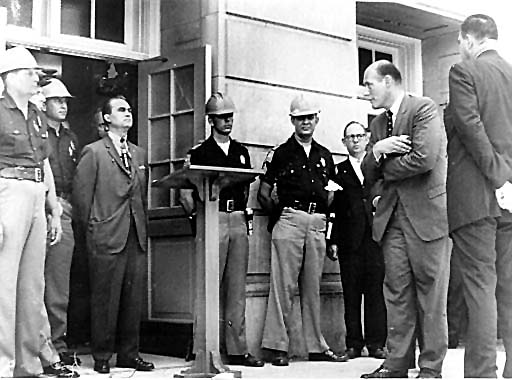
Oh, I remember television scenes of Governor Wallace standing in front of the University of Alabama’s auditorium in 1963 to prevent two African-American students from entering. A staunch believer in segregation, Wallace defied the federal government’s court order that required Alabama to admit Vivian Malone and James Hood. But I had more important things to worry about as a young teenager than the political affairs of Alabama.

Governor Wallace blocking the doors at the University of Alabama in 1963

I cannot identify with the prejudice and bigotry of whites who grew up believing racism and democracy were sisters. So movies depicting the plight of blacks during the decades of segregation and Jim Crow laws always stir my compassion and boil my outrage.

The Help attempts to do just that. Tate Taylor adapted the book by Kathryn Stockett (2009) to the screen and directed the movie that has led at the box office now for three weeks. The acting alone makes the theater experience a blue-chip investment.

Skeeter Phalen played by Emma Stone

A recent ‘62 graduate of Ole’ Miss, Skeeter Phalen (Emma Stone) returns to her home in Jackson, Mississippi to discover a disconnect with her school friends. Neither married nor engaged, she wants to be a journalist and lands a job with the Jackson Journal writing an advice column on cleaning. But she also wants to write a novel.

In the deep south, whites integrated their homes with black servants. Black maids did all the housework and raised the children of their employers. The paltry pay enabled blacks to rent their own shacks in the colored section of town. The social order remained peaceful as long as blacks stayed in the back of the bus and out of the white-only bathrooms.

Skeeter had a strong affection for the black nanny who had raised her and who was absent when she returned home. More liberal than her peers, she is quite comfortable conversing with her friends’ maids in the kitchen. She asks one maid, Aibileen (Viola Davis), to help her write a book. She wants to write about life as a maid in the south from the African-American perspective.

Mississippi law prohibited even advocating for the equality of blacks, but Skeeter was undeterred. Aibileen faced much more severe consequences if she spoke honestly about her life. The Ku Klux Klan terrorized uppity blacks with impunity, but Aibileen’s tragic past persuaded her to take the risk.

Minny Jackson (Octavia Spencer) and Aibileen Clark (Viola Davis)

Secretly meeting in Aibileen’s home, Skeeter begins interviewing her. Aibileen’s best friend, Minny (Octavia Spencer), soon joins the project. Skeeter’s New York editor sees potential in the book, but wants at least ten more maids. The trio cannot persuade any other women to endanger themselves or their families, until the police brutalize one of their cohort during a merciless arrest.

Some criticize the movie for whitewashing history. Besides the arrest scene, the movie refers to the murder of Medgar Evers,a civil rights activist. The KKK shot Evers outside

Civil Rights activist Medgar Evers

his home in Jackson in 1963, in front of his wife and children. Taylor confines his focus to the relational tensions that move the plot. The audience recognizes that the unbridled violence and brutality against blacks forcibly dictated their daily choices.

Skeeter’s book, The Help, scandalizes the town. Although she wrote it anonymously and changed the names of all the characters, the stories unmistakably identify the true setting. Skeeter’s editor offers her a job in New York, but she intends to decline the offer, recognizing the need to provide support to her comrades of social protest. Aibileen and Minny strongly object and convince her that they will be fine without her.

Skeeter, Minny and Aibileen

Aibileen suffers only economic reprisal when her employer’s bigoted friend accuses her of stealing silverware and fires her for her friend. The feel-good ending does sugarcoat the probable results of this assault on the inviolable racism of the south.

The movie should cause white Americans to examine our hearts once again. Racism and prejudice come naturally to all humans, but those possessing social privileges have more freedom to practice it. Skin color, culture, education, religion and a host of other distinctive features can be targeted for exploitation by the social majority.

We need to open our eyes to the realities of injustice that saturate our society, stemming from racial prejudice and economic protectionism. Followers of Christ cannot afford to nurture indifference, because Jesus entrusted the administration of his kingdom on earth to us. Are we perpetuating the existing social order or seeking to apply the principles of Christ’s kingdom to it?

The Help may soften the actual harsh realities of the racial divide of the ‘60s, but it inspires us to speak out with courage against injustice and every form of racism. Followers of Christ should lead the way.

[Further reviews: New York Times, Entertainment Weekly, Huffington Post]

Posted in Movies, Racism | Tagged , , , , | 5 Comments

CHANGE

Our household has been remodeled again. We sent our sixth child off to college last week, leaving only one child at home. We are not yet empty-nesters, but that status will force itself on us in a few short years.

In contrast, last night my wife and I talked with a couple expecting their first child. They are approaching this new phase of their lives cautiously, trying to avoid expectations. We gave them some general advice to prepare them for the upheaval to their current lifestyle, although the shockwaves of this transition usually elude the new parents’ imagination.

Life never stops changing. Changes assert themselves faster in some people’s lives than others. We went from one child to seven over sixteen years. At one time, our garage looked like a Kids ‘R Us with boxes of children’s clothes catalogued by age. Those boxes were replaced with boxes of mementos that each child saved, and even most of those reside with our adult children now.

Seven children compounded routine changes exponentially. Selecting home schooling curriculum to meet the unique educational needs of each child meant that we had to purchase some new books each year. Most children played at least one sport and some changed uniforms three times a year.

We retained one constant in music. Every child had to take piano lessons, so those books became quite worn by the end. Some continued longer than others and some adopted new instruments. We could not stop the changes.

Each child passed through the same developmental stages, but in very different ways with very different needs.

Some might think that after seven children, we would have figured out this parenting thing. The only thing we figured out is that parenting requires increasing wisdom and flexibility, without which you will surely sink. You must expect change.

Ministry changes further exacerbated our home life. Four ministries over 33 years ranks as reasonably stable by current ministry statistics. We managed to move 11 times in two and one-half decades and we have retained our current address longer than any other residence.

Home schooling occupied my wife for 25 years, but 5 years ago she made a major life change by obtaining a part-time position at the local library. That changed last year when she became a full-time employee. She is still adjusting to the jet lag.

Surviving and Thriving in the Empty Nest

I have heard of the empty-nest syndrome most of my life, but I cannot remember ever imagining what it might be like, especially when we were scurrying from piano lessons to soccer fields to dentist appointments to play practices to dance lessons to ball diamonds …. Who has time to sleep, much less to dream about a season of life that seems as possible as a trip to Europe. (Actually, we spent more time considering what the trip might be like, but it never materialized.)

Diapers demanded changing for so long that we could do it in our sleep (and probably did a few times). With a very small budget in our early years of marriage, my wife washed diapers, buying disposables only for trips. She has endured stretches when the washer and dryer ran daily and one load of laundry was a light day. Diaper changes and clothes changes exemplified the changes we were experiencing in our family.

The house has become quieter, but the changes have not lessened. No one prepared us for parenting adult children. Are there any books on this season of life? I suspect that most parents run out of gas before they can write this book. This season has required many new changes in the relationships with our “children” – and their spouses, and our grandchildren. It never ends!

And what lies ahead in this new season? More changes. Bodies wear out, vision blurs, hearing diminishes, energy evaporates. Again, this varies from person to person. Eating healthy and consistent exercise can increase the odds for good health, but they do not guarantee it. Eventually, these changes lead to the cessation of changes on this side of life.

Apparently, God created us with the capability to adapt to change. That ability seems to reside in a relationship with the Unchangeable.

The stability for life comes from “the Father of lights with whom there is no variation or shadow due to change.” (James 1:17) The author of Hebrews describes Jesus as “the same yesterday and today and forever.” (Hebrews 13:8) In theological terms, we call this God’s attribute of immutability, his unchangeableness.

Anchor from the British ship HMS Conway

The divine immutability provides the ballast for human mutability. “So when God desired to show more convincingly to the heirs of the promise the unchangeable character of his purpose, he guaranteed it with an oath, so that by two unchangeable things, in which it is impossible for God to lie, we who have fled for refuge might have strong encouragement to hold fast to the hope set before us. We have this as a sure and steadfast anchor of the soul ….” (Hebrews 6:17-19a)

Unchangeable God. Unchangeable purpose. Unchangeable promises. These enable us to steer our lives through the endless navigational changes that human life requires. He is the anchor of the soul. Don’t let go of him.

Posted in Change, Hope | Tagged , , , , | Leave a comment