GOOD FOR EVIL

“We saw people that were obviously suffering. They felt a great sense of responsibility for what happened. How could we add to their pain displays of anger or anything like that?” Barry Sullivan, father of Declan Sullivan who was killed in a tragic accident at Notre Dame

Alison and Barry Sullivan leaving the funeral for their son, Declan

Did poor judgment lead to the accident? Yes. Were best safety practices followed? No. Did bad decisions contribute to Declan”s death? Yes. Did the Sullivan family decide to sue the university for negligence? No.

In a society where litigation lawyers use marketing like politicians and courts award multi-million- dollar claims like trophies in a youth soccer league, the Sullivans bypassed the legal system. “We never really felt a reason to pursue any kind of legal action,” Sullivan said in an interview with the Chicago Tribune last week.

“It was not our first impulse to go out and hire a lawyer. That’s not the way we’re wired. … We didn’t want to take resources and energy away from other positive things that might happen by tying up people with lawsuits and other actions.”

The Sullivans contented themselves with Notre Dame’s internal investigation, which concluded that “no one acted in disregard for safety.” Instead, “a sudden and extraordinary” wind and inadequate policies contributed to Declan’s death.

Declan Sullivan

Notre Dame’s football program employed the 20-year-old student as a videographer. On the October day Declan was scheduled to film a football practice last year, he wrote on Twitter, “Gusts of wind up to 60 mph today will be fun at work … I guess I’ve lived long enough.”

The football program’s policy prohibited videographers from using the hydraulic lift when winds reached more than 35 mph. The data available to the staff that day did not indicate that winds had exceeded that level. Computer forensics determined that no one had clicked on the wind advisory icon that warned of possible gusts up to 50 mph.

The toppled lift from which Declan was filming

Once on the lift, Declan tweeted, “This is terrifying.” Declan had a propensity for the dramatic, according to his father. But he was not shy and if he really had feared for his safety, he would have taken himself off the lift. He chose to remain on the lift and a severe gust of wind toppled it while scissored 50 feet above the ground. He died soon after reaching the hospital.

The accident prompted Notre Dame and the Indiana Department of Labor to launch the UpRight Campaign. Providing resources to those who use aerial lifts for filming and directing, the campaign urges access to real-time weather information.

The Declan Drumm Sullivan Memorial Fund has received more than $100,000 in donations. The Sullivans directed the fund to Horizons for Youth, a Chicago charity that provides tutoring, mentoring, college preparation courses and need-based scholarships for disadvantaged students. Notre Dame also established a scholarship in Sullivan’s name.

The Sullivan family provides a different wind of fresh air in a greedy and vengeful culture. They have chosen to interpret the tragedy with grace and mercy, reflecting values of a kingdom that transcends this world. Instead of blame, they offered humble understanding. Accidents happen. Sometimes they result from human error. Sometimes not. Imperfect humans make mistakes. I do not know any perfect ones.

Paul commanded, “See that no one repays anyone evil for evil, but always seek to do good to one another and to everyone.” (1 Thessalonians 5:15)

The Sullivans did not try to trace the evil accident back to evil actions. They chose to do good instead. Out of their pain came grace rather than anger.

Paul’s instructions blossom out of Jesus’ teaching and life. Jesus’ standard baffled the religious experts of his day. “Do not resist the one who is evil. But if anyone slaps you on the right cheek, turn to him the other also. And if anyone would sue you and take your tunic, let him have your cloak as well. And if anyone forces you to go one mile, go with him two miles.” Matthew 5:39-41

Jesus not only preached these principles of a higher kingdom, he lived them. When he was beaten and crucified, he never lifted a finger in retaliation. He had the power to direct legions of angels in his defense (Matthew 26:53), but he willingly suffered a severe injustice at the hands of evil men because he knew that a higher Authority rules over all the affairs of men and he executes justice in his time and his way.

The Sullivans have modeled what this looks like in modern culture. May their tribe multiply.

Posted in Character, Forgiveness, Grace, Suffering | Tagged , , , , | 1 Comment

RESISTING RESENTMENT

Here’s the scenario:

Daughter: Why can’t I buy a new dress for the party next week?

Mother: You can buy a dress, but you have to use your own money.

Daughter: You always say that! You never buy me any new clothes!

Mother: Your closet doesn’t look like a scene from Sri Lanka to me. I can recall several shopping trips in the past year.

Daughter: You and dad never give me anything. All my friends drive their own cars to school. Sometimes I wonder if you really care about me at all, or if you are just waiting to get me out of the house.

Mother: Care about you? Do you realize everything we do for you? Do you know how many hours a week I spend just hauling you everywhere you want to go? Who washes your clothes and makes your meals? Who sat at all your softball games, even though you sat on the bench most of the time? Who adjusts our calendars to attend your choir performances? And where do you think the money comes from that pays for your food, your doctor bills, your cell phone and your new iPad? On second thought, forget the party until you get rid of your ungrateful spirit.

What parent cannot identify with this mother? How many times have we felt used and unappreciated? We pour our lives into our children only to be treated like cheap household help.

Have they ever thanked you for one meal? Did they even notice that you had to work overtime to pay for the trip to Disney World? Did they acknowledge the time you spent helping them with their algebra for the test the next day instead of watching the big game?

This mother is wrestling with an insidious infection to relationships: resentment. Resentment results from being injured or insulted by someone. It is the negative response to being hurt.

This devastating emotion often slithers into our souls unnoticed. We might respond in anger or sorrow initially and then “get over it” – so we think.

A close cousin to the more hostile attitude of bitterness, resentment can hide in the crevices of the soul and go undetected as it poisons us.

Paul offers the antidote to this emotional disease in Colossians 3:23-24. “Whatever you do, work heartily, as for the Lord and not for men, knowing that from the Lord you will receive the inheritance as your reward. You are serving the Lord Christ.”

He inserts this principle after advising slaves to obey their masters with a sincerity of heart. It has immediate application to every employee, especially those who feel undervalued or mistreated by their employer. The employee can avoid the cancerous growth of resentment if he recognizes a higher boss.

If you believe God approves of or called you to your employment, then you are really working for him. Your employer may not fairly compensate you or properly commend you for your efforts, but Jesus will reward you in the end. Nothing you do escapes his just and honest eye.

The principle applies in every relationship we have. We often get our feelings hurt when we do something for another person that does not receive the response we expect or deserve. We should consider that act of kindness or generosity was done for Christ, to bring him glory by displaying his love for and in us. He saw it. He also saw our motives. And he will respond to it properly.

Most parents do not bear children to win their praise.

Parents do not normally invest in their children for personal satisfaction. Love usually dictates their actions. This love does not demand anything in return, because it is given for the benefit of the child only.

Nonetheless, those acts of love deserve recognition. They are worthy of commendation. Oftentimes children grow up and become parents themselves. Then one day, changing the diapers of a screaming child while the toddler is demanding attention, a light goes on. The appropriate feelings of gratitude prompt a card or phone call.

If that response never comes, a parent never need suffer the crippling effects of resentment. Whatever you do as a parent, do it for the Lord. He is the one who gave your children to you (Ps. 127:3) and he is the one who empowers you to train them (Deut. 6:6-7; Eph. 6:4).

He will never ignore you or forget you or disappoint you. He notices and appreciates every act of love that you give to your children.

Your faithfulness brings great glory to him. And you will be rewarded.

Posted in Parenting, Resentment | Tagged , , , | Leave a comment

JUDGING HYPOCRISY

Joe Scarborough and Mika Brzezinski interviewing Cornell West and Tavis Smiley on MSNBC show, Morning Joe

People just cannot resist misquoting the Bible in order to support their positions. The MSNBC host of Morning Joe, Joe Scarborough, fell prey to this temptation recently. While interviewing Tavis Smiley and Cornell West, two prominent African-Americans, Scarborough took a swipe at political conservatives for their religious hypocrisy.

Scarborough began hosting the weekday morning talk show in 2007, following a four-year stint with the MSNBC news and analysis show, Scarborough Country. Before that, he gained public attention by winning a seat in Congress as a Republican in a Florida district previously held by the Democrats since 1873. He retired from Congress after three terms.

Joe Scarborough on Morning Joe

In the interview with his guests on “Poverty in America,” Scarborough accused conservatives, who consistently refer to religion in their message, of missing the core of Jesus’ message. To support his critique, he referred to a section of Jesus’ Olivet Discourse in Matthew 24-25.

Scarborough begins badly by mistakenly stating that Jesus spoke in reply to his disciples asking, “Who is getting to heaven? How do we sit on the right hand of the Father?” Actually, the disciples never pose a question about heaven. Heaven did not occupy their thinking. It was the kingdom promised throughout the Old Testament that first-century Jews anxiously awaited, a kingdom on earth ruled by the promised Messiah.

The disciples did not ask about sitting on the right hand of the Father, either. They believed that Jesus was the promised Messiah and two of his disciples, James and John, asked specifically if they could sit on his right hand and left hand when he brought the kingdom to reality and sat on his throne. They made this request on a different occasion from the Olivet Discourse.

The Olivet Discourse ensued from a prediction that Jesus made about the total destruction of the Temple. Then his disciples asked, “When will these things be, and what will be the sign of your coming and the close of the age?” (Mt 24:3) Jesus’ lengthy response has generated extensive debate over its interpretation, particularly what it says about the end times.

So Scarborough begins by revealing he is a stranger to the biblical text or that he gives little attention to details – details that might color the meaning of the passage. 

He continues by correctly quoting Matthew 25:34-36 (since he read it from a Bible), “Then the King will say to those on his right, ‘Come, you who are blessed by my Father, take your inheritance. For I was hungry and you gave me something to eat. I was thirsty and you gave me something to drink. I was a stranger and you invited me in. I needed clothing and you clothed me. I was sick and you looked after me. I was in prison and you came to visit me.’”

In this passage, Jesus discusses the final judgment of nations, when he, as King, will separate the sheep form the goats. Those he welcomes into his kingdom have demonstrated a compassion for the broken and distressed, those who suffer from living in a fallen world. Jesus refuses entrance to those who did not display this kind of compassion.

Scarborough wants to reduce the scope of Jesus’ ministry to economic relief. “That was Jesus talking about, when asked, what his ministry was about. It was about taking care of the poor.” What about the other groups mentioned by Jesus? Does Scarborough think that only the poor are strangers or sick or in prison? I wonder if Jesus will ignore acts of compassion towards abused children or battered women or victims of bullying. Was Jesus really talking about only the poor?

It is interesting that in all four gospels, Jesus never once personally gave money to the poor. The gospels record dozens of miraculous healings and even a miraculous supply of wine at a wedding feast, but no charitable donations.

We do know that on one occasion, when a woman anointed Jesus with expensive perfume, Judas grumbled, saying the perfume could have been sold and the money given to the poor. Jesus explained that the woman had done a good thing, because “the poor you always have with you, but you do not always have me.” (Jn 12:7)

This does not reject the idea that those who breathe the air of Christ’s kingdom should have compassion for the poor and act to meet their basic needs of food, clothing and housing. This theme echoes from book to book through the Scriptures.

It begs the question, How? Does Jesus expect a government to forcibly tax its citizens and use a portion of that tax for programs of compassion? Some would argue that a government that fails to extend assistance to the poor is guilty of moral negligence. How much assistance is required? Would raising a family’s standard of living barely above the poverty line and not to the mean of middle class living still be morally insensitive?

Numerous ministries to the poor currently exist, but they severely lack funding. Are those who decry the inadequacy of government entitlement programs making personal donations to private ministries and programs? If not, that would seem hypocritical.

It is also hypocritical to selectively invoke the name of Jesus and his words for personal agendas, while disregarding other teachings of Jesus.

Is Scarborough as concerned about Jesus’ statement, “I am the way, and the truth, and the life. No one comes to the Father except through me” (Jn 14:6)? Or does he take Jesus seriously when he says, “You shall love your neighbor as yourself,” (Mt 22:39) or “So therefore, any one of you who does not renounce all that he has cannot be my disciple” (Lk 14:33)?

No question about it. Followers of Christ not only have a deep compassion for the weak, the distressed, the broken and the poor, but they also have a deep respect for everything that Jesus said. Scarborough should pay close attention to Jesus’ words in Matthew 7:1, “Judge not, that you be not judged.”

Posted in Biblical Authority, Compassion, Politics and Christianity, Poverty | Tagged , , , , , , , , | Leave a comment

LOVING CHILDREN AND TEENS

Almost Christian by Kenda Creasy Dean

I have previously referred to the work done by sociologist, Christian Smith, in his seminal research, the National Study on Youth and Religion (NSYR), conducted in 2003-2005. His book, Soul Searching, emerged from that study. Continued research produced Souls in Transition.

Kenda Creasy Dean served as one of the researchers on Smith’s team. She has written a book based on the research also, Almost Christian: What the Faith of Our Teenagers Is Telling the American Church. In her book, Dean holds local churches accountable for the disappointing condition of the spiritual lives of American teens.

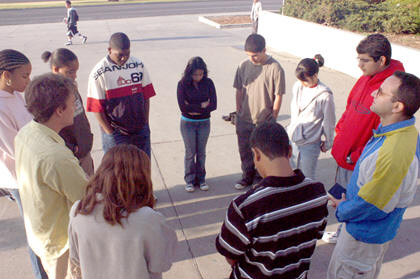
Teens praying at school flagpole

A small percentage of teens confesses and demonstrates a strong commitment to faith in Jesus Christ. Dean has identified four characteristics of those teens: “they could tell a personal and powerful story about God; they belonged to a significant faith community; they exhibited a sense of vocation; and they possessed a profound sense of hope.”

The role of community in developing vital faith in teens provides an interesting commentary on Christian community, especially in light of last week’s article, “Comparing Two Communities.” Dean says, “Caring congregations help teenagers develop what social scientists call ‘connectedness,’ a developmental asset accrued from participating in the relational matrix of authoritative communities – communities that provide young people with available adults, mutual regard, boundaries, and shared long term objectives.”

This finding contests conventional wisdom on the value of adult-teen relationships. For decades the church has invested its resources in creating vital youth ministries. Conceding to the culture of teenage peer dependency, churches have sought to create a sub-culture where teens can depend upon other Christian teens more heavily than unbelieving peers.

The NSYR does not deny the significance of peer friendships for mutual encouragement and support in their faith, but it also reveals an equal importance in the role of significant adult relationships to the spiritual lives of teens. One teen commented, “I know if I couldn’t talk to my parents about something, I’m pretty comfortable with [other adults in the congregation].”

Meaningful relationships do not pop up automatically like tulips in spring. They require time and consistent personal interaction. They grow out of mutual respect and earned trust. The gap in experience and maturity between adults and teens requires intentionality in pursuing the kind of connectedness that fosters a sense of safety and value in teens.

Teens who grow up in one church have a distinct advantage over those who attend two or three churches during their spiritual development. Even this does not ensure the necessary ingredients for connections of support, because adults must actively pursue valued and nurturing relationships with the young people in their community.

Sunday School teachers and youth leaders have unique opportunities to provide the necessary connectedness that teens need for deep spiritual commitment. These adults can do much more than merely transmit the truths needed for an enduring faith. They should recognize the real potential of their position to create lasting relationships with their students that have proven essential to perpetuating the faith community.

Dean identifies ten traits of the authoritative community:

  • It is a social institution that includes children and youth.
  • It treats children as ends in themselves.
  • It is warm and nurturing.
  • It establishes clear limits and expectations.
  • The core of its work is performed largely by nonspecialists.
  • It is multigenerational.
  • It has long-term focus.
  • It reflects and transmits a shared understanding of what it means to be a good person.
  • It encourages spiritual and religious development.
  • It is philosophically oriented to the equal dignity of all persons and to the principle of love of neighbor.

These findings should cause every local church to evaluate its core values. An environment that promotes and sustains multigenerational relationships should occur somewhere in that matrix of values. Program development should acknowledge the importance of interactions between adults and children.

Loving your neighbor is not age specific. The small multigenerational churches may play a larger role in the continuity of the faith community from one generation to the next than we have thought. Adults can make enormous investments in God’s kingdom through children and teen ministries and through the natural opportunities of church communal life – if we will.

Posted in Community, Spiritual Formation, Teens | Tagged , , , , | Leave a comment

COMPARING TWO COMMUNITIES

“If the essence of religious identities is not your beliefs about God but your membership in a God-seeking community, then the ultimate heresy is not to deny the existence or attributes of God but to deny your obligations to the people around you, and the most severe punishment is not to cut you off from God (can any human being do that to another?), but to cut you off from the surrounding community.”     Rabbi Harold Kushner

Rabbi Harold Kushner’s first book, When Bad Things Happen to Good People, became an instant success. Kushner demonstrated a compassionate and sensitive heart as he grappled with the perennial questions about good and evil and the reason behind human suffering. He later wrote To Life in 1994. In it, he attempted to explain Judaism, which he believes to be the answer to the real problem of life. He asserts that Judaism provides the best path to being fully human.

According to Kushner, being Jewish relates more to a communal identity than to a system of beliefs. “One of the most important differences between Judaism and Christianity is that we were a people before we had a religion.” He refers to the existence of Abraham’s descendants as an ethnic population (over two million when they left Egypt) before they received the law at Mt. Sinai and entered into a covenant relationship with God.

This view seems to minimize the theological origin of the Jewish community. Abraham was selected by God to father a nation, with whom God would enter into a covenant and entrust his law. The nation would become God’s witness to idolatrous nations that the one true God exists and rules over heaven and earth.

Jewish wedding celebration

For Kushner, the community defines Judaism more than its theology. He does not deny the importance of Jewish beliefs, but arriving at an accurate interpretation of God and his work ranks behind faithful participation in Jewish communal life. The primacy of ethnic identity compares to the blood-is-thicker-than-water principle of life. The community is family and you accept family no matter what, with all its theological aberrations.

He contrasts this with Christianity, which begins with a belief. That belief grants entrance into a faith community. Without certain core beliefs, one remains outside this community. It is no less a community, but it is defined by belief rather than birth. In fact, ethnicity should never cause division within the faith community. “There is neither Jew nor Greek … for you are all one in Christ Jesus.” (Galatians 3:28)

New Testament authors compare the relational connections in the faith community to a building, a family and a human body. They describe the Christian community in the same terms Kushner defines the Jewish community, but with a different structure.

At the center of this community and circumscribing its borders is Jesus Christ. Jesus defines, delimits, informs and inspires this community. Relation to him secures relation with every other member of the community.

Uptown Assembly of God - a multiethnic community

The individualism of American society has greatly diminished our understanding of community. This has produced significant mobility between local church communities. If members disagree with one another over beliefs or practices, they separate, joining another local community or forming a new one. People usually gravitate away from diversity and toward homogeneity.


Dilution of diversity redefines the community. Local communities begin to emphasize the qualities that distinguish them from other local communities.

Although they share the same core beliefs that define them as a single faith community, they can easily demote those beliefs in order to characterize each local community by secondary attributes.

This perpetual division and redefinition erodes the unity that Jesus envisioned for his community.

On the night before he was crucified, Jesus asked the Father “that they may be one even as we are one. I in them and you in me, that they may become perfectly one, so that the world may know that you sent me.” (John 17:22-23) This intrinsic unity exists by virtue of the relationship every believer has with Christ, but a visible extrinsic unity remains blurred.

So how should we interpret Kushner’s contrast between Judaism and Christianity? Judaism clearly possesses an ethnic dimension, but that ethnic existence originated with a belief, that God had chosen Abraham and his descendants for a special role in redemptive history. Theology preceded the community. To emphasize the community over theology devalues the calling and mission of the community.

The Christian community likewise exists because of God’s calling and mission for it. Just as Israel was to bear witness to the reality of the one true God, so the Church is called to the same mission. The community plays a key role in that witness.

When we allow secondary issues to divide that community, ignoring the essential solidarity we share in Christ, we too forfeit our calling and mission.

Judaism and Christianity may be more alike than we realize.

Posted in Christianity and Judaism, Community | Tagged , , , , , | Leave a comment